
What a Roof Replacement Actually Costs in Tulsa in 2026 (And Why You Should Run From Anyone Promising You a Free One)
If you have started shopping for a roof replacement in Tulsa, Broken Arrow, Bixby, Owasso, or anywhere across the metro, you have probably noticed two frustrating things. First, almost no roofing company will give you a straight answer about price online. Second, the contractors who do quote prices fast tend to come in suspiciously low, often with promises of "free roofs," "no out-of-pocket cost," or "we'll handle your insurance and you won't pay a dime." Both of those experiences are pieces of the same problem, and that problem costs Tulsa homeowners thousands of dollars every year.
This is a no-fluff breakdown of what a roof replacement actually costs in the Tulsa metro in 2026, what drives the price up or down, what is included and excluded in a real estimate, and why the "free roof" pitch you keep hearing is almost always either illegal under Oklahoma law, structured around inflated insurance fraud, or hiding shortcuts that show up as leaks and warranty problems years later.
Tier-One Roofing has been doing this work in Green Country since 2014. The team gives homeowners honest numbers up front because honest numbers are the foundation of a relationship that holds up when something goes wrong. Here is what those numbers actually look like.
What a Roof Replacement Costs in Tulsa Right Now
The honest answer to "what does a new roof cost in Tulsa" is a range, because every roof is different. But the range is narrower and more predictable than most online calculators suggest, and you should know what it is before you take any contractor's bid seriously.
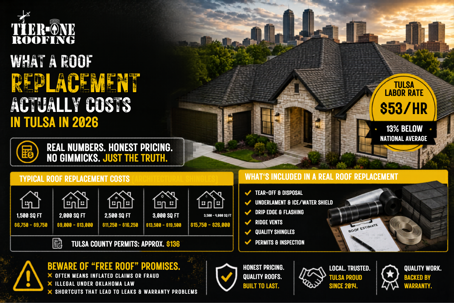
For a standard architectural asphalt shingle roof installed in 2026, Tulsa-area pricing runs roughly $4.50 to $6.50 per square foot of roof area, including tear-off, disposal, underlayment, drip edge, flashing, ridge vents, ice and water shield in critical areas, the shingles themselves, and labor. The Tulsa labor rate sits around $53 per hour, which is below the national average and is part of why Tulsa-area roof replacements are typically about 13 percent below national-average pricing on equivalent scopes.
Translating that per-square-foot range into real-world numbers for typical Tulsa homes:
A 1,500 square foot roof, common on smaller ranch homes around Tulsa, Broken Arrow, and Sand Springs, generally lands at $6,750 to $9,750 for an architectural asphalt shingle replacement.
A 2,000 square foot roof, common on mid-sized homes across Bixby, Jenks, Owasso, and Sapulpa, generally lands at $9,000 to $13,000.
A 2,500 square foot roof, common on larger family homes in Tulsa, Owasso, and the OKC metro, generally lands at $11,250 to $16,250.
A 3,000 square foot roof, common on larger homes and homes with multiple gables, generally lands at $13,500 to $19,500.
A 3,500 to 4,000 square foot roof, common on luxury homes and complex multi-gable designs, can range from $15,750 up past $26,000.
For Class 4 impact-resistant shingles, which qualify for an Oklahoma insurance premium discount and are strongly recommended in Tulsa given the hail environment, expect to add roughly $1 to $2 per square foot to the asphalt pricing above, depending on the manufacturer and product line.
For standing seam metal roofing, Tulsa pricing runs roughly $8 to $10 per square foot installed, putting a typical 2,000 square foot metal roof in the $16,000 to $20,000 range. Stone-coated steel and exposed-fastener metal panels run somewhere between asphalt and standing seam pricing depending on the specific product.
Tulsa County permits add roughly $136 to the project total, which is typically included in a full-service contractor's bid.
Those are real 2026 numbers from a contractor who quotes them every week. If you are getting bids from multiple companies and one of them comes in dramatically below this range, the question to ask is what corners are being cut to make the math work.
If you want a real, line-itemed estimate for your specific home with no high-pressure sales pitch, schedule a free roof inspection from Tier-One Roofing. Call 918-393-4682 in Tulsa or 405-458-8656 in Oklahoma City, or book online at tier-oneroofing.com.
What Actually Drives the Price Up or Down
The per-square-foot ranges above assume a relatively standard roof. The five factors below explain why your specific bid might land at the low end, the high end, or above the high end. Understanding these factors before you talk to contractors prevents surprises.
Roof pitch. A standard pitch of 4/12 to 6/12 (the slope ratio that describes how many inches the roof rises per 12 inches of horizontal run) is the easiest to work on and carries baseline labor pricing. Pitches of 7/12 to 9/12 add 10 to 15 percent to labor cost because crews need additional safety equipment and work slower. Pitches of 10/12 and above can add 20 to 40 percent because the crew often needs roof jacks, harnesses, and slower, more deliberate movement on every shingle. If your home has a steep multi-gable design, your bid will reflect it.
Roof complexity. Penetrations such as chimneys, skylights, plumbing vents, dormers, and HVAC vents all add labor because flashing has to be hand-fabricated and installed around each one. A simple gable roof with one or two penetrations is the cheapest scope. A complex multi-gable roof with multiple valleys, chimneys, dormers, and skylights can add 15 to 25 percent over the base calculation. Valleys in particular eat labor and require ice and water shield underlayment that adds material cost.
Tear-off and decking surprises. Most Tulsa roofs being replaced today are existing single-layer asphalt shingles, and a single-layer tear-off is included in standard pricing. If your home has two layers of existing shingles (a previous owner shingled over the original instead of tearing off), the second layer adds roughly $1 to $2 per square foot for additional removal labor and disposal. Once the old shingles are off, the contractor inspects the wood decking. If sections of decking are rotted, water-damaged, or otherwise compromised, those sections have to be replaced before the new roof can be installed. Decking replacement typically runs $70 to $100 per sheet of plywood or OSB plus labor. A reputable Tulsa contractor will plan for some decking replacement in the bid and tell you up front that additional decking discovered during tear-off will be billed at a stated rate. A budget buffer of about 15 percent is smart in 2026 to account for whatever the tear-off reveals.
Material grade. Three-tab shingles are the cheapest option and the worst choice for Oklahoma. They are rated to roughly 60 mph wind, which fails repeatedly during Oklahoma severe weather events. Architectural or dimensional shingles, which are the standard recommendation, carry significantly higher wind ratings and a longer lifespan. Class 4 impact-resistant shingles cost more up front but can qualify your home for Oklahoma insurance premium discounts that pay back the upgrade over the life of the roof. FORTIFIED-rated shingles meeting the IBHS Hail Impact standard are the highest tier and can unlock the Oklahoma Strengthen Oklahoma Homes grant of up to $10,000 plus wind insurance discounts up to 42 percent.
Accessibility. Two-story homes cost more to roof than single-story because of additional safety equipment, scaffolding, and slower work pace. Homes with limited driveway access for material delivery and dumpster placement can add labor. Homes near power lines or with overgrown landscaping that has to be worked around add labor. None of these factors are dramatic on their own, but they accumulate.
When you add up pitch, complexity, tear-off conditions, material grade, and accessibility, two homes of identical square footage in the same Tulsa neighborhood can have roof replacement costs that differ by $4,000 or more. That is normal. What is not normal is a contractor who refuses to walk through these factors with you when explaining their bid.
What Should Be Included in a Real Estimate
A real, professional roof replacement estimate in Tulsa should include all of the following items, broken out clearly so you can compare bids on equal terms:
Tear-off of all existing roofing material, including disposal fees and dumpster rental.
Inspection and replacement of damaged decking at a stated per-sheet rate.
Synthetic underlayment over the entire roof deck (not the older felt underlayment that some low-bid contractors still use).
Ice and water shield underlayment in valleys, around penetrations, and along eaves where Oklahoma's freeze-thaw cycles can cause ice damming.
Drip edge metal flashing along the eaves and rakes.
New flashing around chimneys, skylights, vents, and any wall-to-roof transitions.
The shingles themselves, with the manufacturer, product line, and color stated explicitly.
Ridge vents and any other ventilation work needed to bring the attic into proper code-compliant ventilation.
Ridge cap shingles or hip and ridge product matching the field shingle.
Tulsa County permits and inspections.
Labor for installation, including the nail pattern (which should be six nails per shingle, not the four-nail minimum that some low-bid contractors use to save time).
Cleanup, including magnetic nail sweeps of the yard, driveway, and surrounding areas.
A workmanship warranty in writing, separate from the manufacturer's material warranty.
If a contractor's bid does not break out these line items, you cannot compare it to other bids meaningfully. If the bid is a single number with "roof replacement: $X," you are looking at either a contractor who does not want you comparing scope, or a contractor who has not actually scoped your roof carefully. Either way, push for the line-itemed version before signing anything.
Tier-One Roofing provides line-itemed estimates as a standard practice. Every customer gets a clear breakdown of what is included, what the materials are, and what the warranty terms are before any work begins. Schedule a free, no-pressure inspection at 918-393-4682 or visit tier-oneroofing.com to see what an honest estimate looks like.
Why the "Free Roof" Pitch Is Almost Always a Trap
Now for the part that costs Tulsa homeowners real money. After every significant hailstorm in Oklahoma, neighborhoods get blanketed by roofing crews going door to door with some version of the same pitch: "We can get you a free roof through your insurance," "We'll handle everything and you won't pay anything," "Your deductible? Don't worry about it, we'll cover it."
Every version of this pitch is a problem. Some versions are illegal in Oklahoma. Other versions are technically legal but structurally dishonest. Here is the honest breakdown.
Deductible-eating is illegal in Oklahoma. Since 2022, Oklahoma House Bill 1940 has made it illegal for any roofing contractor or third party to waive, absorb, pay, or rebate any portion of a homeowner's insurance deductible when replacing a roof as part of an insurance claim. This is not a guideline. It is state law. Any contractor offering to "pay your deductible," "rebate it back to you," "absorb it into the bid," or "make it disappear" is breaking the law. Participating in this arrangement as the homeowner can also expose you to insurance fraud allegations and put your coverage at risk. When a storm chaser tells you they will pay your deductible, your only correct response is to ask them to leave.
"Free roof" through insurance is misleading even when it is legal. An honest version of this pitch goes something like, "If your insurance approves a full roof replacement, the carrier will pay for it minus your deductible." That part is true. The deceptive version layers in an implication that the contractor will somehow eliminate the deductible too, which is the part that makes the whole pitch illegal under HB 1940. Reputable contractors will tell you up front that you are responsible for your deductible and will help you understand the financing options that exist if cash flow is tight.
Inflated insurance claims are fraud. Some contractors who promise "free" roofs do so by inflating the scope of the insurance claim to cover the deductible amount, padding the bid with line items the carrier ends up paying for that did not actually need to be done. This is insurance fraud. It is investigated. Carriers have entire claims investigation departments built around catching it. When the fraud gets caught, the homeowner is the one whose claim gets denied, whose policy gets non-renewed, and who sometimes faces personal liability.
Skipped scope is the other version of "free." When a contractor's bid is dramatically lower than the legitimate market range, the math has to work somewhere. Common shortcuts include skipping ice and water shield in valleys and along eaves, using felt instead of synthetic underlayment, using four nails per shingle instead of six, skipping ridge vent replacement, reusing damaged flashing instead of replacing it, and skipping decking inspection and replacement entirely. Every one of these shortcuts saves the contractor money up front and creates a leak vulnerability that shows up six months to two years later, after the contractor is gone and the warranty is meaningless.
Storm chasers leave town when problems show up. Even when the work itself is technically acceptable, a contractor who is not a permanent local Tulsa-area business has no incentive to honor warranties or come back to fix issues. The roof has a 25 to 30 year manufacturer warranty. The contractor's workmanship warranty might be 5 or 10 years. None of those warranties matter if the company that installed the roof has packed up and moved to the next storm.
The "free roof" pitch is engineered to feel like a homeowner is getting away with something. In reality, the homeowner is the one taking on all the risk, while the contractor collects the insurance check and disappears. This is why the Tulsa-area homeowners who have been through it twice almost always come back to a permanent local roofer for the third installation.
The Permanent Local Contractor Difference
The single most important variable in your roof replacement, more than the price, more than the brand of shingle, more than the warranty terms, is whether the company that installs your roof is going to still be answering the phone at the same number five and ten years from now.
Tier-One Roofing has been operating in the Tulsa metro since 2014. The license number 80002404 is published openly on every page of the website, which makes it easy to verify with the Oklahoma Construction Industries Board. The physical office at 2013 South Elm Place in Broken Arrow is a real address with real people. The phone number rings to a real person. The Oklahoma City office at 405-458-8656 serves the OKC metro with the same standards.
The team is veteran-owned and operated. Founder Jonathan Marsh is a US Army Ranger, Blackhawk pilot, and combat veteran who started the company because he saw a gap in the Tulsa market for a roofing company that operated with the kind of standards he was trained to operate by in the military. The team is FORTIFIED-certified for the Oklahoma Strengthen Oklahoma Homes grant program. The team is experienced with VA grant project work for disabled veterans. The team installs to the manufacturer's specifications without shortcuts, six nails per shingle, full synthetic underlayment, ice and water shield in valleys and along eaves, new flashing on every penetration, and proper ventilation.
When something needs attention three or five or eight years from now, the same company is here, the same number rings, and the same warranty applies. That is not a small thing. It is the entire point of paying real-market pricing for a real installation.
Honest Financing Options
Not every Tulsa homeowner has $10,000 to $20,000 in cash sitting available for a roof replacement, even when the roof clearly needs to come off. The honest path here is not the illegal "we'll cover your deductible" pitch. It is real financing options that let you spread the cost.
Insurance claim financing. If your roof has storm damage that justifies an insurance claim, the carrier covers the bulk of the replacement minus your deductible. The deductible is your responsibility. If cash flow is tight, financing the deductible specifically is far smaller than financing a full replacement, and many local lenders offer terms that are very manageable on a typical Oklahoma percentage-based wind and hail deductible.
Home improvement financing. Most reputable Tulsa-area roofers, including Tier-One Roofing, partner with home improvement lenders who can finance a full or partial roof replacement at competitive interest rates with terms ranging from 24 months to 144 months. These are real, transparent loan products with stated rates and terms.
Strengthen Oklahoma Homes grant. Oklahoma's SOH program provides up to $10,000 in grant funding paid directly to the contractor for FORTIFIED roof upgrades. Combined with Class 4 insurance discounts and the long-term durability benefit, this can dramatically reduce the homeowner's out-of-pocket exposure. Tier-One Roofing's owner is FORTIFIED certified and walks homeowners through this program.
Home equity options. For homeowners with significant equity, a HELOC or home equity loan can fund a roof replacement at lower interest rates than unsecured home improvement financing. This is a longer process to set up but worth considering for larger projects.
VA grants for qualifying veterans. Disabled veterans with qualifying service-connected disabilities may be eligible for SAH, SHA, or TRA housing grants that can include roof work as part of a larger adaptation project.
The honest version of "we'll work with you on the cost" is real financing, real grant programs, and real conversations about what fits your budget. The dishonest version is "free." Run from the dishonest version.
What to Do Before You Sign Anything
If you are at the point of comparing bids and trying to make a decision, here is the straight checklist for protecting yourself.
Verify the contractor's Oklahoma license number through the Oklahoma Construction Industries Board database. Tier-One Roofing's license number 80002404 is published openly. Any contractor who hesitates when you ask for their license number is showing you something.
Get the physical address of the company's permanent office. Confirm it exists. A storm chaser's "office" is often a UPS Store box or a residential address.
Ask how long the contractor has been operating in Oklahoma specifically. Anything under three years should raise questions.
Ask for at least three references from customers in the Tulsa metro from the last 12 months. Call them.
Get the bid in writing with all of the line items listed in the section above. Compare bids on equal terms.
Read the workmanship warranty in writing. If the warranty is verbal or vague, it does not exist.
Confirm in writing that you are responsible for your deductible. Anyone who tries to tell you otherwise is breaking Oklahoma law.
Do not sign a contract on the spot, especially after a door-knock. A contract that requires "today only" pricing is a contract designed to bypass your due diligence.
If something feels off, it probably is. Trust the instinct.
Why Tier-One Roofing Quotes Honestly
The roofing industry has earned a lot of skepticism in Oklahoma. Storm chasers, deductible-eaters, contractors who disappear, contractors who pad bills, contractors who skip steps to underbid honest competitors. Tulsa homeowners have heard most of it.
Tier-One Roofing operates differently because the company was built differently. Veteran-owned. Locally based. Permanent address. Real license number. Real reviews. Real warranties. The team handles roof repair, roof leak repair, full installations including metal roofs, roof inspections, roof maintenance, roof coatings, storm damage restoration, gutter repair and installation, the full insurance claims process, FORTIFIED roof installations under the Oklahoma Strengthen Oklahoma Homes grant program, and VA grant project work for disabled veterans. The service area covers Tulsa, Broken Arrow, Bixby, Owasso, Jenks, Sand Springs, Sapulpa, Glenpool, Collinsville, Skiatook, Claremore, Verdigris, Inola, Catoosa, Coweta, Mounds, Muskogee, Okmulgee, Grove, Grand Lake, Bernice, Sperry, Jay, Langley, and the broader Oklahoma City metro.
When you ask for a price, you get a real price. When you ask what is included, you get a line-itemed scope. When you ask about the warranty, you get it in writing. When something needs attention five years from now, you call the same number you called the first time, and the same team shows up.
That is what real roofing is supposed to look like. The fact that most homeowners now find that combination remarkable is a measure of how broken the rest of the industry has become.
If your roof needs replacement and you want to talk to a contractor who will give you straight numbers, walk you through the actual options, and stand behind the work for the long haul, Tier-One Roofing is the call to make.
Schedule a free roof inspection and itemized estimate today. Tulsa: 918-393-4682. Oklahoma City: 405-458-8656. Visit tier-oneroofing.com to book online. Honest pricing, honest scope, honest answers from a permanent local team.