
How Disabled Veterans in Tulsa Can Use VA Housing Grants for Adapted Roofing and Home Modifications (And Why Most Roofing Companies Will Not Touch These Projects)
There is a category of work Tier-One Roofing does that almost nobody in the Tulsa-area roofing industry handles. It is not the most common work in the company. It is not the most profitable. It is some of the most important work the team takes on, because it is roofing and home modification work tied to VA housing grants for disabled veterans, and every project is for a fellow service member.
If you are a disabled veteran in Oklahoma trying to figure out how the VA's housing grant programs work, what they actually pay for, whether your roofing project qualifies, and why so few contractors in this market will help you navigate them, this is the breakdown you need. Jonathan Marsh, the owner of Tier-One Roofing and a US Army Ranger, Blackhawk pilot, and combat veteran, built this company specifically to be the kind of contractor that fellow veterans could trust to do this work right. The VA grant project work is part of how he keeps that promise.
This is the no-fluff guide to the four VA housing grant programs that can fund home modifications including roof work, who qualifies, how much they pay in fiscal year 2026, what to expect from the process, and how to get a roofing contractor on your team who actually knows how to work inside the VA system.
The Four VA Housing Grant Programs You Need to Know
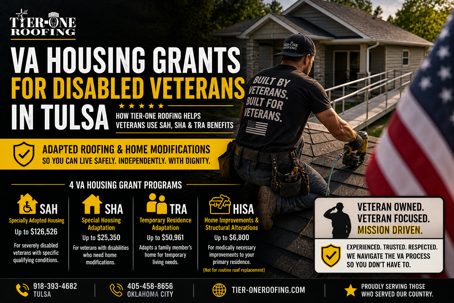
The Department of Veterans Affairs administers four distinct housing grant programs aimed at helping disabled veterans modify their homes for safe, independent living. Most veterans have heard of one or two. Few understand how they fit together or how roofing work specifically fits into each one. Here is the framework.
Specially Adapted Housing (SAH) grant. The largest of the VA housing grants. For fiscal year 2026, the maximum SAH grant is $126,526. This grant is designed for veterans with severe service-connected disabilities and is intended to fund the building, buying, or major adaptation of a home that is structurally rebuilt around the veteran's needs. SAH eligibility is narrow and tied to specific qualifying conditions. Loss or loss of use of both legs requiring use of a wheelchair, braces, crutches, or canes. Blindness in both eyes with 20/200 visual acuity or less, combined with loss or loss of use of one lower extremity. Loss or loss of use of one lower leg along with the lasting effects of an organic disease or injury. Severe burn injuries. Loss or loss of use of one or more lower extremities resulting from service after September 11, 2001. The SAH grant can be used up to six times across a veteran's lifetime, as long as the cumulative total stays within the program cap.
Special Housing Adaptation (SHA) grant. The smaller adapted housing grant for veterans whose qualifying disabilities do not meet the SAH threshold but still require meaningful home modifications. For fiscal year 2026, the maximum SHA grant is $25,350. SHA qualifying conditions include blindness in both eyes (20/200 or less corrected vision), loss or loss of use of both hands, severe burn injuries, and certain respiratory conditions. Like SAH, the SHA grant can be used up to six times, with the total staying within the program cap.
Temporary Residence Adaptation (TRA) grant. For SAH or SHA-eligible veterans who are temporarily living in a family member's home. TRA funds modifications to the family member's home to accommodate the veteran's needs without requiring ownership. For fiscal year 2026, the maximum TRA grant is $50,961 for SAH-eligible veterans and $9,100 for SHA-eligible veterans. TRA usage counts as one of the six lifetime SAH or SHA usages.
Home Improvements and Structural Alterations (HISA) grant. Run through VA Health Administration rather than VA Loan Guaranty, this grant is for medically necessary improvements and structural alterations to a veteran's primary residence. Maximum amount in fiscal year 2026 is $6,800 for service-connected conditions and $2,000 for non-service-connected conditions. HISA funds things like roll-in showers, widened doorways, accessible kitchen counters, and ramps to allow safe entry and exit from the home. Important note for roofing specifically: HISA explicitly excludes routine maintenance items like roof replacements, furnaces, and air conditioners. HISA is generally not the right tool for a straight roof replacement project.
That last paragraph is critical, and it is one of the most misunderstood parts of the VA grant landscape. People hear "VA grants pay for home repairs" and assume any veteran with a service-connected disability can get a new roof through the VA. The truth is more specific. HISA does not cover routine roofing. SAH and SHA can cover roofing, but only when it is part of a larger qualifying adaptation project tied to the veteran's disability. The work has to fit the program rules. The contractor has to know how to scope it correctly.
If you are a disabled veteran in the Tulsa area trying to figure out whether your roofing or home modification project qualifies for VA grant funding, schedule a conversation with Tier-One Roofing. The team has direct experience walking veterans through these programs and will give you a straight answer about what is and is not possible. Call 918-393-4682 in Tulsa or 405-458-8656 in Oklahoma City, or visit tier-oneroofing.com.
Where Roofing Work Fits Inside the VA Grant Programs
Here is how a roofing scope can legitimately fit inside an SAH or SHA grant project. Consider a veteran who qualifies for SAH because of loss of use of both lower extremities. The grant is intended to fund the major structural adaptation of the home, which often includes things like rebuilding the front entrance for wheelchair access, widening hallways, reconstructing the bathroom for roll-in shower access, lowering kitchen counters, and reworking electrical and HVAC systems to accommodate medical equipment. In many of these projects, the structural work necessitates roofing modifications. Adding a covered ramp at the entrance changes the roofline. Building a new accessible bathroom addition adds new roof area. Reconfiguring the layout of the home to accommodate a wheelchair-accessible primary suite may involve removing and rebuilding portions of the existing roof. Even a project that simply requires extensive interior structural changes often involves roof work to ensure the building envelope stays intact and the modifications are weather-tight.
The same logic applies to SHA projects, just at a smaller scale. A veteran with blindness in both eyes might use SHA funds for a series of accessibility improvements that include changes to the home's exterior, requiring associated roofing work to maintain the building envelope.
What does not fit: a straight "my roof is old and I am a disabled veteran, can VA pay for a new roof" request. The VA grant programs are not roof replacement programs. They are accessibility and disability-adaptation programs that sometimes include roof work as a component of a larger qualifying project. Understanding that distinction up front saves veterans a lot of time and frustration.
This is also why so few roofing contractors do this work. A typical roofing project for a private homeowner is straightforward: site visit, estimate, contract, schedule, install, invoice, done. A VA grant project involves working with a VA-assigned Specially Adapted Housing agent, coordinating with the veteran's broader contractor team if there is one, scoping the work to fit within the grant's approved purposes, navigating VA approval timelines, dealing with VA-specific documentation, and often interfacing with other professionals like occupational therapists who help define the veteran's specific needs. It takes more time. It takes more patience. The contractor has to actually understand the program rules and be willing to work inside them.
A lot of contractors take one look at the paperwork and pass. Tier-One Roofing does not pass. The team takes these projects because they are part of why the company exists.
Why a Veteran-Owned Roofing Contractor Matters Here
When you are a disabled veteran trying to navigate a VA grant project, the contractor you hire is going to spend time inside your home, sometimes for weeks, while major modifications are being made. The work being done is often deeply personal: it is about regaining independence, restoring access to parts of your own home, and making your living space fit a body that has been changed by service to the country.
This is not a project you want to hire out to a contractor who has never served, has never worked with the VA, and does not understand what any of this means.
Jonathan Marsh, the owner of Tier-One Roofing, is a US Army Ranger, a former airborne infantry soldier, a Blackhawk helicopter pilot, and a combat veteran. He founded Tier-One Roofing in 2014 with a specific commitment to veteran service: the Wounded Warrior Project and Soldiers Wish Foundation are part of the company's stated mission. The team is intentional about the way veterans are treated when they walk in the door, when the contractor is in the home, and when the project is being closed out and handed back to the homeowner.
That cultural commitment is the biggest reason veterans get referred to Tier-One Roofing for grant project work. Veterans tell other veterans where to go. They do not refer their fellow service members to contractors who treat the work like a transaction or who do not understand the weight of the project being done. Tier-One has built a reputation in the Tulsa-area veteran community as a contractor who shows up, listens carefully, scopes the work honestly, and does the project right.
For specialized VA grant project work, that kind of cultural fit matters as much as the technical roofing skill.
How the VA Grant Application and Project Process Actually Works
For veterans who think they may qualify for SAH, SHA, or TRA grants, the process moves through a specific sequence. Knowing what to expect up front prevents a lot of frustration.
Step one is determining eligibility. When a veteran is rated for disability by the VA, the agency typically sends VA Form 26-4555c, the Application in Acquiring Specially Adapted Housing or Special Home Adaptation Grant. If a veteran has a qualifying service-connected disability and was not sent the form, they can request it directly from VA at 1-800-827-1000 or download VA Form 26-4555 online.
Step two is application submission. The completed VA Form 26-4555 can be submitted online through VA.gov, by mail to a VA regional office, or in person. The application asks for documentation of the qualifying disability, current housing situation, and intended use of the grant.
Step three is VA review and assignment of an SAH agent. Once the application is approved, VA assigns a Specially Adapted Housing agent to work with the veteran throughout the project. This agent is the veteran's primary point of contact for project planning, contractor coordination, and grant disbursement. The SAH agent helps the veteran understand what types of modifications are eligible under the grant and provides guidance on contractor selection.
Step four is contractor selection. VA may recommend contractors who have experience with adapted housing projects, but the veteran has the right to choose any contractor. The contractor must be willing to work within the VA's project process, which includes scope approval, periodic inspections, and VA-specific documentation. This is the step where most veterans run into roadblocks. Many contractors will simply decline to work on VA grant projects because of the additional process complexity.
Step five is project scope and bid. The veteran and the chosen contractor develop a detailed scope of work for the modifications. The scope must align with the grant's approved purposes and include all itemized line items for materials and labor. If roofing work is part of the project, it has to be tied to the qualifying adaptation purpose.
Step six is VA approval of the scope and bid. Before any construction work begins, VA reviews the proposed scope and bid to confirm it qualifies for grant funding. This review can take time. Veterans should plan for the approval phase to add weeks to the overall project timeline.
Step seven is construction. Once approved, the contractor performs the work according to the scope. Periodic VA inspections may occur during construction.
Step eight is project completion and grant disbursement. When the work is finished and inspected, VA pays the grant funds, often directly to the contractor. If project costs exceed the grant amount, the veteran is responsible for the difference, which can be paid out of pocket, financed, or partially funded through other programs.
It is a process. It works. But it requires a contractor who is willing to operate inside the VA's framework rather than trying to fit VA work into a standard private-residential workflow.
Tier-One Roofing has experience working through the VA grant process for Tulsa-area veterans. If you are at any point in the application or project planning phase and need a roofing contractor who understands how this works, call 918-393-4682 or 405-458-8656. Free initial consultations for veterans considering a VA grant project.
Other Programs That Can Help Tulsa-Area Veterans With Roofing Costs
The VA's adapted housing grants are not the only resources available to Tulsa-area veterans dealing with roofing or home repair costs. A few others worth knowing about:
Habitat for Humanity Repair Corps. Funded by The Home Depot Foundation, this program provides critical home repairs for veterans, including roof repairs, accessibility modifications, and other essential improvements. The program is open to veterans with honorable or general discharges who own and occupy their homes. Local Tulsa-area Habitat affiliates can provide more details on availability and waitlists.
Rebuilding Together Veterans at Home. A national nonprofit network providing no-cost home modifications and repairs to veterans and their families. Services focus on safety, accessibility, and independence. Operates through local affiliates.
Operation Homefront. Provides emergency financial assistance for veterans and military families, which can sometimes be applied toward critical home repairs depending on the situation.
USDA Section 504 Home Repair Loans and Grants. Available to very low-income homeowners in rural areas, including many parts of Oklahoma outside the Tulsa metro core. Loans of up to $40,000 at 1% fixed interest, and grants of up to $10,000 for homeowners 62 and older. Combined assistance up to $50,000.
Strengthen Oklahoma Homes (SOH) FORTIFIED roof grant program. Open to all qualifying Oklahoma homeowners, including veterans. Provides grants of up to $10,000 toward upgrading a roof to the FORTIFIED standard, which can lower wind insurance premiums by up to 42 percent. Tier-One Roofing's owner Jonathan Marsh is FORTIFIED certified, which means veterans pursuing the SOH grant can have the work done by the same trusted local contractor.
Local veteran service organizations. The American Legion, Veterans of Foreign Wars (VFW), Disabled American Veterans (DAV), and Wounded Warrior Project may have local chapters with case workers who can connect veterans to contractors and additional financial resources.
For veterans dealing with a roofing problem and trying to figure out what combination of programs might apply, the smartest first step is a free consultation with a contractor who understands all of these tools. There may be one program that fits, or there may be several that combine to fully fund the project. Knowing the landscape changes the conversation entirely.
What to Watch Out For
There are a few warning signs every disabled veteran should be aware of when working through home repair or modification decisions, especially after a storm event when out-of-state contractors flood Oklahoma neighborhoods.
Be wary of any contractor who promises VA grants pay for everything. They do not. The VA programs have specific eligibility rules, dollar caps, and approval processes. A contractor who tells you that VA will fully fund a roof replacement with no out-of-pocket cost is either misinformed or being dishonest.
Be wary of any contractor who offers to handle the entire VA process for you with no involvement on your part. The VA's grant programs require the veteran to be the applicant and the decision-maker. A legitimate contractor will support you through the process, not bypass you.
Be wary of any contractor who pressures you to sign a contract immediately. VA projects move on VA's timeline, not on a contractor's commission timeline. Anyone using high-pressure sales tactics on a disabled veteran is showing you who they are.
Be wary of any contractor who is not local. VA grant projects involve potentially weeks of work in your home and sometimes months of process management. A contractor with no permanent local address and no track record of Tulsa-area work is going to be hard to hold accountable when something needs attention three months from now.
Be wary of any contractor who cannot tell you specifically which VA grant programs apply to your situation. If they have not done this work before, they should not be learning on your project.
The contractor you bring into your home for a VA grant project is going to be part of one of the most consequential home improvements you make as a disabled veteran. Choose carefully. Choose someone who has done this work, who understands the VA system, and who treats the project with the respect it deserves.
Why Tier-One Roofing Stands in This Specific Niche
Most Tulsa-area roofing contractors do not advertise VA grant project work because most do not do it. The added complexity, the longer timelines, the VA-specific documentation, and the relatively small volume of these projects compared to insurance restoration work makes it easy for contractors to pass.
Tier-One Roofing does this work because it fits the company's purpose. Jonathan Marsh built Tier-One Roofing as a veteran-owned business with veterans in mind. The company is a proud sponsor of the Wounded Warrior Project and Soldiers Wish Foundation. The team is willing to spend the extra time required to scope a project correctly inside a VA grant program, work with the veteran's SAH agent, navigate the approval process, and stand behind the work after the grant is closed.
The technical roofing capability is the same that the company brings to every project: licensed, insured, locally based, with a permanent office at 2013 South Elm Place in Broken Arrow, Oklahoma license number 80002404, and a warranty that the company will still be around to honor. The veteran-specific cultural fit is what makes this niche work feel like the right place to spend the time.
Tier-One Roofing serves Tulsa, Broken Arrow, Bixby, Owasso, Jenks, Sand Springs, Sapulpa, Glenpool, Collinsville, Skiatook, Claremore, Verdigris, Inola, Catoosa, Coweta, Mounds, Muskogee, Okmulgee, Grove, Grand Lake, Bernice, Sperry, Jay, Langley, and the broader Oklahoma City metro. The team handles roof repair, roof leak repair, full installations including metal roofs, roof inspections, roof maintenance, roof coatings, storm damage restoration, gutter repair and installation, and the full insurance claims process. For veterans pursuing VA grant project work specifically, the team brings the additional experience and willingness to operate inside the VA's framework that most contractors will not provide.
If you are a disabled veteran in the Tulsa area exploring your VA housing grant options, considering a home modification project, dealing with a roofing issue and trying to figure out what programs might apply, or just looking for a contractor who served and understands what that means, Tier-One Roofing is the right call.
Schedule a free consultation today. Tulsa: 918-393-4682. Oklahoma City: 405-458-8656. Visit tier-oneroofing.com to book online. Veteran-owned, veteran-focused, locally based, and committed to doing this work the right way for the people who served.