
Are Metal Roofs Actually Worth It for Tulsa and Oklahoma City Homes? An Honest 2026 Breakdown
Metal roofing is one of the fastest-growing residential categories in Oklahoma, and for good reason. Hail keeps coming. Wind keeps coming. Asphalt shingles keep ending up in the gutter every five to seven years. Homeowners who have replaced their roof twice already are starting to ask whether there is a way to break the cycle.
Metal might be that way. Or it might not be, depending on your specific home, your specific budget, and your specific tolerance for the ways metal roofs differ from shingles. Most articles you will find online about metal roofing are written by manufacturers or by contractors who only install metal, which means they tell you metal is the answer to every roofing question ever asked. That is not the truth. Metal is the right answer for some Oklahoma homes and the wrong answer for others.
This is the no-fluff breakdown of how metal roofing actually performs in Oklahoma conditions, what the real 2026 cost premium is over architectural shingles, the differences between standing seam, exposed fastener, and stone-coated steel systems, the insurance and resale implications, and the honest cases where metal pays off versus the cases where it does not. Tier-One Roofing installs metal roofs as one of the company's core services across the Tulsa metro and Oklahoma City metro, and the team is comfortable telling homeowners when metal is the right call and when it is not.
How Metal Roofs Actually Perform Against Oklahoma Hail
The single most important question for Oklahoma homeowners considering metal is how it stands up to hail. The answer is more nuanced than the marketing suggests.
Metal roofing is significantly more durable than asphalt shingles in nearly every weather scenario except direct, severe hail impact. In high winds, metal panels with proper concealed-fastener installation can withstand sustained winds of 140 mph or higher, which is well above what asphalt shingles handle. In thermal cycling, metal expands and contracts predictably without the granule loss and shingle brittleness that age asphalt roofs prematurely. In UV exposure, the painted finishes used on quality metal roofing systems carry 30-year to 40-year color warranties, which is roughly double the realistic lifespan of asphalt in Oklahoma sun.
For hail, the picture is different. Metal roofing does not crack, split, or lose granules the way asphalt does, which means metal does not develop the slow leak vulnerabilities that asphalt does after a hail event. However, metal can dent. Hail two inches in diameter or larger, which Oklahoma sees regularly during severe weather season, can leave visible cosmetic dents in standing seam panels, exposed fastener panels, and especially the smoother flat sections of any metal system. The structural integrity of the roof is typically not compromised, meaning the roof still does its job of keeping water out. But the cosmetic damage is real and visible, and homeowners who select metal need to make peace with that possibility before they install.
Stone-coated steel handles hail differently than smooth metal panels. The textured granular surface and the panel profile both help disguise small to moderate hail dents, which is why stone-coated steel has gained traction in hail-prone markets like Oklahoma. Standing seam metal in heavier gauges (24-gauge versus the lighter 26-gauge or 29-gauge options) holds up to hail better but still shows dents from larger stones.
The honest summary: metal is dramatically more durable than asphalt against everything except severe hail, where it trades shingle replacement risk for cosmetic dent risk. For most Oklahoma homeowners, that trade favors metal. For homeowners who cannot tolerate any visible roof imperfections, the trade is harder to justify.
What Metal Actually Costs in Oklahoma in 2026
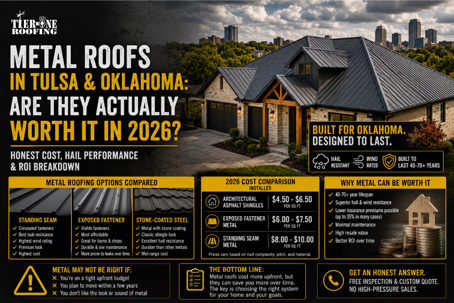
Real 2026 pricing for metal roofing in the Tulsa and OKC metros runs roughly $8 to $12 per square foot installed, depending on the system type and the complexity of the roof. That puts a typical 2,000 square foot Oklahoma home in the $16,000 to $24,000 range for a metal roof replacement, compared to $9,000 to $13,000 for a comparable architectural asphalt shingle replacement.
Breaking down by system type:
Exposed fastener metal panels, sometimes called R-panel or 5-V crimp, are the most affordable metal option at roughly $7 to $9 per square foot installed. These panels are common on agricultural and commercial buildings and are increasingly used on residential. The fasteners are visible across the panel surface, which is part of what keeps the cost down but also creates more long-term maintenance points where neoprene gaskets eventually need to be replaced.
Standing seam metal, where the panels lock together at raised vertical seams with concealed fasteners, runs roughly $10 to $14 per square foot installed depending on gauge, finish, and roof complexity. This is the higher-end residential metal option and the standard for new luxury construction. Standing seam carries longer warranties, better wind performance, and a cleaner aesthetic than exposed fastener systems.
Stone-coated steel panels, which look like architectural shingles or tile but are made of stamped steel with a stone-granule coating, run roughly $9 to $12 per square foot installed. These systems are popular in hail-prone markets because the textured surface masks dents better than smooth metal panels.
For comparison, architectural asphalt shingles in Tulsa and OKC run roughly $4.50 to $6.50 per square foot installed, and Class 4 impact-resistant asphalt shingles add roughly $1 to $2 per square foot to that.
The cost premium for metal over standard asphalt is typically 60 to 100 percent. The cost premium over Class 4 impact-resistant asphalt is closer to 40 to 70 percent. That is the honest math homeowners need to start with.
If you want a real, line-itemed estimate comparing metal and asphalt options for your specific home, schedule a free inspection from Tier-One Roofing. Call 918-393-4682 in Tulsa or 405-458-8656 in Oklahoma City, or book online at tier-oneroofing.com. The team will walk you through both options without pushing you toward one or the other.
Lifespan and Long-Term Cost Math
The case for metal is built almost entirely on the long-term cost math, not the up-front cost. Here is what that math actually looks like in Oklahoma conditions.
A quality architectural asphalt shingle roof in Oklahoma realistically lasts 12 to 17 years before needing replacement. The manufacturer warranty might say 25 or 30 years, but the average shingle roof in Oklahoma fails earlier because of hail damage, UV degradation, and thermal cycling. The Tulsa metro averages roughly five hail days per year, and the cumulative wear from those storms reduces shingle lifespan well below the warranty figure.
A quality standing seam metal roof in Oklahoma realistically lasts 40 to 60 years, with the painted finish potentially needing refresh somewhere in years 25 to 40 depending on the product. Stone-coated steel typically lasts 40 to 50 years. Exposed fastener systems last 30 to 40 years if the gaskets are maintained.
Run the math on a 2,000 square foot home over a 50-year horizon:
Asphalt shingle path: replace at year 0, replace again around year 15, replace again around year 30, replace again around year 45. That is four installations over 50 years. At $11,000 average per installation in 2026 dollars (and prices will rise), the cumulative spend is roughly $44,000 in today's dollars, more in inflated future dollars.
Metal path: install at year 0, refinish or repaint potentially once around year 30 to 35, and that is it. Cumulative spend is roughly $20,000 to $25,000 in today's dollars.
Even adjusted for the time value of money and the fact that you might not own the home for 50 years, the math favors metal for any homeowner who plans to stay in their home long-term. For a homeowner who plans to sell within five to ten years, the math is closer because the up-front cost premium is harder to recover at resale.
There are also annual operating costs that favor metal. Cool-rated metal roofing finishes reflect solar heat and can reduce summer cooling bills by 10 to 25 percent in Oklahoma's hot summer months. Over 30 to 50 years, that energy savings adds up to a meaningful number that asphalt cannot match.
Insurance Implications, Both Good and Bad
Metal roofing has a complicated relationship with Oklahoma homeowners insurance. Some carriers love metal and offer significant premium discounts. Other carriers have specific cosmetic damage exclusions that affect how metal roof claims are handled. You need to know which side your carrier is on before you install.
The good news first. Most Oklahoma carriers recognize metal roofing as more durable against wind and hail than asphalt and offer wind and hail premium discounts on metal roofs that can run from 10 percent to 30 percent depending on the carrier and the specific metal system installed. Stone-coated steel and standing seam metal in heavier gauges typically qualify for the highest discount tiers. The discounts can be stacked with other home discounts and over the life of the roof can recover a meaningful portion of the up-front cost premium.
Now the part most homeowners do not hear about until it is too late. Many Oklahoma carriers attach a cosmetic damage exclusion or cosmetic damage limitation specifically to metal roofs. The clause typically reads something like: "We will not pay for cosmetic damage to metal roofing materials caused by hail or wind, including but not limited to denting, marring, scratching, or pitting that does not impair the structural integrity or watertight performance of the roof." In plain English, if hail dents your standing seam panels but the roof still keeps water out, your carrier can decline to replace the dented panels under your hail coverage.
The cosmetic exclusion is not universal. Some carriers do not include it. Some carriers include it as an option that can be removed for a higher premium. Some carriers include it automatically and quietly without much disclosure. Before you install a metal roof, you need to read your homeowners policy specifically, ask your agent about cosmetic damage coverage on metal roofing, and get the answer in writing.
There is also a distinction between Admitted Carriers and Surplus Lines Carriers in Oklahoma that affects how guaranteed your discounts and coverage are. Admitted Carriers are subject to Oklahoma Insurance Department oversight and must honor stated policy terms. Surplus Lines Carriers operate outside that framework and have more flexibility to limit coverage in ways that surprise homeowners. If you have flexibility on which carrier you use, an Admitted Carrier offering metal roof discounts is generally the safer path.
The honest summary on insurance: metal can save you 10 to 30 percent on premiums but can also expose you to cosmetic damage exclusions that limit your hail coverage. Both pieces have to be evaluated together for your specific carrier before you make the decision.
Standing Seam vs Exposed Fastener vs Stone-Coated Steel
For Oklahoma homeowners who decide metal is the right direction, the next question is which metal system to install. The three main options each have a different best-fit profile.
Standing seam is the premium residential option and the right choice for most Oklahoma homes where budget allows. The concealed fastener system means there are no visible screws across the panel face, which improves both aesthetics and long-term weather performance because there are fewer penetrations through the metal. Standing seam comes in a wide range of profiles (snap-lock, mechanical lock, nail strip) and gauges (24-gauge for premium, 26-gauge for standard residential, 29-gauge for budget). For Oklahoma's hail and wind conditions, 24-gauge standing seam in a quality finish is the gold standard. The aesthetic works on modern homes, ranch homes, and traditional architecture. Lifespan is 40 to 60 years. Cost premium puts it at the high end of the metal range.
Exposed fastener panels (R-panel, 5-V crimp, ribbed metal) are the budget metal option and are common on rural Oklahoma homes, agricultural buildings, and budget-conscious residential installations. The screws are visible across the panel surface, which keeps installation cost down but creates ongoing maintenance points. The neoprene gaskets that seal each fastener typically need to be inspected and selectively replaced every 10 to 15 years to prevent leaks. The aesthetic is industrial and works better on rural homes, farmhouses, and outbuildings than on suburban residential. Lifespan is 30 to 40 years if maintained, less if not. Cost premium is at the low end of the metal range, sometimes only modestly above Class 4 asphalt.
Stone-coated steel is the hail-camouflage option and has gained significant traction in Oklahoma. The granular textured surface masks small to moderate hail dents far better than smooth metal panels, which addresses the biggest cosmetic concern Oklahoma homeowners have about metal roofing. The panels are available in profiles that mimic shake, tile, or shingle aesthetics, which broadens the architectural fit. Stone-coated systems carry strong wind warranties and impact ratings. Lifespan is 40 to 50 years. Cost premium puts it in the middle of the metal range.
For most Oklahoma homeowners, the decision matrix is roughly this: if the budget supports it and the aesthetic fits, standing seam in 24-gauge with a quality finish is the best long-term investment. If hail cosmetic concerns dominate the decision, stone-coated steel is the right hedge. If budget is the primary constraint and the aesthetic of an exposed fastener system is acceptable, exposed fastener metal is still meaningfully better than asphalt over the long run.
Tier-One Roofing installs all three metal systems and walks every customer through the trade-offs before any work begins. If you want to talk through which option fits your specific home, schedule a free consultation at 918-393-4682 or visit tier-oneroofing.com.
What Metal Roofing Does Not Solve
The honest version of this conversation has to include the things metal does not fix.
Metal does not fix poor decking. If the wood decking under your existing roof is rotted or compromised, it has to be replaced before any new roof goes on, metal or otherwise. Decking work adds cost and is not the metal roof's fault.
Metal does not fix poor ventilation. If your attic is improperly ventilated, switching to metal does not solve the moisture and heat issues that come from inadequate ridge and soffit airflow. Proper ventilation has to be designed and installed alongside the new roof regardless of material.
Metal does not fix poor flashing. The transitions between the roof and chimneys, walls, skylights, and vents are where most leaks actually start. Metal panels installed over poor flashing leak just as fast as shingles installed over poor flashing. Quality flashing work is non-negotiable.
Metal is not silent. Properly installed metal roofs over a sealed deck and proper underlayment are nearly as quiet as shingle roofs during rain. But metal installed without proper underlayment, or installed directly over open framing as is sometimes done in budget agricultural builds, can be noticeably louder during heavy rain. For residential installations done correctly, this is rarely a real issue, but homeowners coming from a quiet shingle roof should know what to expect.
Metal does not eliminate insurance hassles. A metal roof reduces the frequency of claims because it is more durable, but a metal roof on a home with a cosmetic damage exclusion can produce insurance disputes after major hail events that asphalt homes do not face. Understand your policy before you install.
Metal does not work on every roof pitch. Most residential metal systems require a minimum pitch of 3/12, with some standing seam systems requiring 1/12 or 2/12 minimums. Very low pitch roofs may not be candidates for traditional metal panels and may require alternative systems.
These are not deal-breakers. They are honest disclosures that should be part of every metal roof conversation before any contract is signed.
When Metal Is the Right Call and When It Is Not
Putting all of this together, here is the honest decision framework for Oklahoma homeowners.
Metal is the right call when you plan to stay in the home for at least 10 to 15 years, when budget supports the up-front premium, when your insurance carrier does not impose cosmetic damage exclusions or you can get them removed, when you want to break the every-five-to-seven-years asphalt replacement cycle, when you value the long-term cost math over short-term cash outlay, and when you are buying a home you genuinely intend to live in long-term.
Metal is also the right call for homes where the architectural fit is strong, particularly modern homes, contemporary designs, and traditional ranch homes where standing seam aesthetics work, and for homes in rural Oklahoma where exposed fastener metal is part of the local architectural vernacular.
Metal is the wrong call when you plan to sell within three to five years and cannot recover the cost premium at resale, when budget is genuinely tight and Class 4 impact-resistant asphalt would be a smart alternative, when your insurance carrier imposes broad cosmetic damage exclusions that cannot be removed, when the architectural style of your home does not fit metal aesthetically, and when you cannot tolerate any risk of visible cosmetic dents from severe hail.
Metal is also the wrong call if a contractor is pushing you toward it without walking through the trade-offs honestly. Metal sales people who treat metal as a universal answer should be approached skeptically. The right answer for any specific home depends on the specific home.
For homeowners in the middle, where metal makes sense long-term but the up-front cost is hard to absorb today, the honest alternative is Class 4 impact-resistant asphalt installed to FORTIFIED standards, which can unlock the Strengthen Oklahoma Homes grant of up to $10,000 plus wind insurance discounts up to 42 percent. That combination delivers meaningfully better durability than standard asphalt at significantly lower cost than metal, and is the right answer for many Tulsa and OKC homeowners who want better protection without the metal premium.
What to Ask Before You Sign a Metal Roof Contract
If you are at the point of comparing metal roofing bids, the questions below separate honest contractors from sales-driven ones.
What is the gauge of the metal? 24-gauge is premium, 26-gauge is standard residential, 29-gauge is budget. The bid should specify which.
What is the finish warranty? Quality painted finishes carry 30-year to 40-year color warranties. Anything shorter is below standard.
What is the substrate underlayment? High-temperature synthetic underlayment is the right answer. Felt is not.
What is the hidden fastener system on standing seam? Mechanical lock is more weather-resistant than snap-lock. The bid should specify.
How is the metal handled at penetrations and transitions? Metal flashing, fabricated to match the panel, properly sealed.
What is the workmanship warranty? In writing, with stated terms, separate from the manufacturer warranty.
What is your installation experience with this specific metal system? Metal installation is more demanding than asphalt and contractor experience matters enormously.
How do you handle expansion and contraction? Metal moves seasonally and the installation has to accommodate it. Ask how.
What does my insurance carrier say about cosmetic damage on this system? A good contractor will help you understand the insurance side, not avoid it.
If a contractor cannot answer these questions confidently, they are not the right contractor for a metal roof installation.
Why Tier-One Roofing for Metal in Oklahoma
Metal roofing requires more skill than asphalt installation. The panels are less forgiving. The flashing details are more complex. The expansion and contraction has to be properly accounted for. The fastener selection and pattern matters more. A metal roof installed by a contractor who does it occasionally is a metal roof that develops problems early. A metal roof installed by a contractor who installs metal regularly is a metal roof that delivers the lifespan and performance the system is capable of.
Tier-One Roofing has been installing metal roofs as a core service since the company was founded in 2014. Standing seam, exposed fastener, and stone-coated steel are all part of the regular installation menu. The team trains specifically on metal installation techniques, works with the metal manufacturers' technical specifications, and stands behind the work with workmanship warranties that mean something because the company is permanently based in Broken Arrow with Oklahoma license number 80002404 and is going to be at the same phone number five and ten years from now.
Founder Jonathan Marsh is a US Army Ranger, Blackhawk pilot, and combat veteran who built the company on a no-shortcuts standard. The same standard applies to every metal installation. Six fasteners per panel where the spec calls for it. Proper underlayment. Proper flashing. Proper expansion accommodation. Proper attention to the details that determine whether a metal roof lasts 25 years or 50 years.
The service area covers Tulsa, Broken Arrow, Bixby, Owasso, Jenks, Sand Springs, Sapulpa, Glenpool, Collinsville, Skiatook, Claremore, Verdigris, Inola, Catoosa, Coweta, Mounds, Muskogee, Okmulgee, Grove, Grand Lake, Bernice, Sperry, Jay, Langley, and the broader Oklahoma City metro. The team handles roof repair, roof leak repair, full installations across all materials, roof inspections, roof maintenance, roof coatings, storm damage restoration, gutter repair and installation, the full insurance claims process, FORTIFIED roof installations under the Oklahoma Strengthen Oklahoma Homes grant program, and VA grant project work for disabled veterans.
If you are evaluating metal roofing for your Tulsa or OKC area home and want a contractor who will give you the honest case for and against metal, walk you through the system options, and stand behind the installation for the long haul, Tier-One Roofing is the call to make.
Schedule a free metal roofing consultation today. Tulsa: 918-393-4682. Oklahoma City: 405-458-8656. Visit tier-oneroofing.com to book online. Honest answers, real installation expertise, and a contractor who will be here for the life of your roof.