
What Actually Causes Roof Leaks in Oklahoma Homes (It Is Almost Never What Tulsa Homeowners Think)
A water spot appears on your bedroom ceiling. The drywall starts to bubble. You hear dripping in the attic during a storm. Your first thought is the obvious one: a shingle came off, water is getting through the hole, the roof needs to be patched or replaced. That is sometimes correct. Most of the time, it is not.
Roof leaks in Tulsa-area homes almost never come from the place homeowners assume they come from. The water you see on the ceiling is rarely directly under the actual entry point. The damaged shingle that looks bad from the ground is rarely the source of the leak you are dealing with inside. The real causes of roof leaks in Oklahoma homes follow a pattern, and understanding that pattern is the difference between a $400 flashing repair done correctly the first time and a $4,000 problem that gets misdiagnosed three times before someone finally figures out what is actually wrong.
This is the no-fluff guide to how roof leaks actually happen in Oklahoma homes, the order in which Tulsa-area roofers should be checking for the source, what you can investigate safely yourself before calling for help, what to do in the immediate term to limit interior damage, and how to tell when a leak is a symptom of something larger that needs full roof attention rather than a spot repair.
Tier-One Roofing has been responding to leak calls across the Tulsa metro and Oklahoma City metro since 2014. The team has seen every version of this. Here is the honest framework.
Why the Ceiling Stain Is Almost Never Directly Under the Leak
The first thing every homeowner needs to understand about roof leaks is that water does not fall straight down once it gets through the roof. It travels.
When water enters a roof system through a flashing failure, a nail pop, a damaged shingle, or any other entry point, it lands on the underside of the decking or runs down the underlayment until it hits a low point or an obstruction. From there it follows the path of least resistance, which often means traveling several feet horizontally along a rafter or joist before finally dripping down through insulation and onto the drywall ceiling below. By the time you see a stain in the bedroom, the actual point of entry might be 10 or 15 feet away in any direction.
This is why DIY roof leak diagnosis based on the location of the interior stain almost always gets the wrong answer. Roofers who chase the stain without thinking about water travel patterns end up patching the wrong thing, watching the leak come back, and patching another wrong thing. The right diagnostic process starts inside the attic, traces the water back to the source, and then identifies what is happening on the exterior at that source point.
If you have an attic with reasonable access and you can do this safely, the first thing to do when you spot a ceiling leak is go up into the attic during the next rain event with a flashlight and look for the actual entry point. Water tracks on rafters and decking are usually visible. Trace them back to the highest dry point and you will be close to the actual source. Mark that location somehow. That is the information your roofer needs to fix the problem efficiently.
If the attic is not safely accessible, or the leak is severe, or you simply do not want to be up there during a storm, calling a professional is the right call. The diagnostic skill is what you are paying for, not just the patching labor.
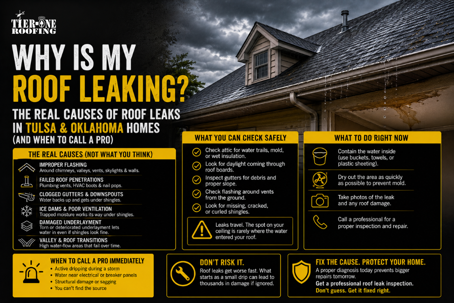
The Real Causes of Roof Leaks in Oklahoma Homes, Ranked by Frequency
In our experience installing and repairing roofs across Tulsa, Broken Arrow, Bixby, Owasso, Jenks, and the surrounding metro, the actual causes of residential roof leaks fall into a predictable hierarchy. Here is the list ranked roughly by how often each one is the actual culprit.
Flashing failures around chimneys, vents, and skylights. This is the single most common cause of roof leaks in Oklahoma homes, and it is dramatically underdiagnosed by inexperienced roofers. Flashing is the metal trim that seals the transition between the roof and any vertical surface or penetration. Chimneys, plumbing vents, HVAC vents, attic vents, skylights, dormers, and any wall-to-roof transition all require flashing. Over time, flashing fails for several reasons. The sealant behind step flashing on chimneys deteriorates from UV exposure and freeze-thaw cycles. Pipe boots around plumbing vents crack as the rubber gasket ages, typically within 10 to 15 years on Oklahoma roofs because the UV exposure accelerates breakdown. Skylight flashing develops gaps as the structure flexes seasonally. Counter flashing on chimneys works loose. When any of these fail, water enters at the flashing and the leak shows up somewhere below. Properly diagnosing and repairing flashing requires actually getting on the roof and inspecting the specific transition. A new flashing installation, with proper integration into the surrounding shingles, is the right fix when the existing flashing has failed. Flashing failures are repairable without a full roof replacement in most cases.
Pipe boots and vent gaskets that have aged out. Closely related to flashing but worth calling out separately because of how common it is. The rubber or neoprene gaskets around plumbing vent pipes and other roof penetrations have a finite lifespan, typically 10 to 15 years in Oklahoma sun. When they crack, the seal at the base of the vent pipe fails and water runs down the pipe into the attic. The fix is straightforward, replace the boot, and the cost is modest. But the leak presentation is identical to a much more serious decking or shingle failure, which is why this gets misdiagnosed regularly.
Nail pops and exposed nail heads. Asphalt shingles are nailed through the shingle into the decking. Over time, thermal cycling can cause some nails to back out slightly, lifting the shingle above and exposing the nail head to weather. Each exposed nail head is a potential entry point for water, especially during wind-driven rain events. Nail pops can occur randomly across an aging roof and are particularly common on roofs that are 10 years old or older. The fix is replacing the affected shingles and resetting the nails properly, which is usually straightforward. But if nail pops are widespread, that is often a signal that the roof is aging out and needs broader attention.
Damaged or missing shingles from wind events. Oklahoma's straight-line wind events lift shingles, break the sealant strip that bonds shingles together, and occasionally tear shingles off entirely. When a shingle is missing or damaged, water has direct access to the underlayment and decking below. This is the cause of leak that homeowners assume is most common, and while it does happen, it is actually less frequent than flashing or nail pop issues. The fix is straightforward shingle replacement, but the proper diagnosis includes checking for sealant strip failures on shingles that look intact but are no longer bonded down.
Hail damage that did not leak immediately. This one is sneaky. Hail rarely causes immediate leaks, because hail damage to asphalt shingles typically takes the form of bruising and fractured granule beds rather than holes through the shingle. The bruised shingle continues to keep water out for a while, but the fractured granule bed accelerates UV breakdown of the asphalt mat below. Six months to two years after a hail event, the bruised shingles begin to fail and leaks develop in places where the homeowner had no idea hail damage existed. This is why post-storm inspections matter even when no leaks are present, and why the Oklahoma insurance claim deadline of 12 to 24 months from the date of loss is so important to be aware of.
Ice damming during winter cold snaps. Less common than the hail and wind issues but worth noting because it does happen in Oklahoma's occasional severe winter weather. When snow accumulates on a roof and the attic is improperly ventilated, heat from the home melts the underside of the snow layer. The meltwater runs down the roof, hits the colder eave or gutter area, and refreezes into an ice dam. Subsequent meltwater pools behind the dam and can back up under the shingles, leaking into the home. The fix is a combination of ice and water shield underlayment along the eaves (which should be standard on any Oklahoma roof installation), proper attic insulation, and proper attic ventilation. Ice damming is a system failure, not a single-component failure.
Skylight failures. Skylights are notorious leak points in Oklahoma homes for several reasons. The flashing around the skylight is exposed to severe weather, the seals between the glass and the frame degrade over time, and the skylight itself can develop hairline cracks from hail strikes. Older skylights, particularly those installed more than 20 years ago, are often beyond serviceable repair and need to be replaced as part of any roof leak resolution. Skylight replacement is a specific skill set and not every roofer does it well.
Improper underlayment installation. When a roof was installed with felt underlayment instead of synthetic, or with synthetic but improperly lapped, or with felt that was exposed to UV for too long during installation, the underlayment can fail in ways that create leak vulnerabilities. This is most common on roofs installed by storm chasers or budget contractors who cut corners on materials and installation method. There is no good repair for this short of redoing the affected sections, which is why selecting a contractor who installs to proper standards in the first place matters.
Decking deterioration. Less common as a primary leak cause but worth noting. Wood decking that has been water-damaged from a previous undetected leak can develop weak spots, sag, and create new leak paths even after the original surface issue is fixed. Catching decking issues during a leak repair is part of what experienced roofers do during the diagnostic process.
Gutter problems that look like roof problems. Sometimes what appears to be a roof leak is actually a gutter problem. Clogged gutters can cause water to back up under the eave shingles and create the appearance of a roof leak. Detached or improperly pitched gutters can dump water against the side of the house and create wall and foundation moisture issues that present as ceiling stains in adjacent rooms. A thorough roof leak diagnosis includes checking gutter function, not just roof condition.
This list explains why the right answer to a roof leak is rarely "your roof is shot, you need a full replacement." Sometimes it is, particularly when the underlying issue is widespread shingle aging or significant hail damage across the entire roof. But often the right answer is targeted repair work that solves the actual problem at a fraction of the cost of replacement.
A roofer who walks into a leak situation and immediately recommends full replacement without doing the diagnostic work is showing you something. Honest roofers diagnose first and recommend the appropriate scope of work second.
Got a leak right now? Call Tier-One Roofing for fast roof leak repair across the Tulsa metro and Oklahoma City metro. 918-393-4682 in Tulsa, 405-458-8656 in OKC. Same-day service available for active leaks. Or book online at tier-oneroofing.com.
What You Can Check Yourself Before Calling
Some of the diagnostic work that helps a roofer fix your problem efficiently can be done by the homeowner before the contractor arrives. None of this requires getting on the roof, which is dangerous and should be left to professionals with proper safety equipment.
Check your gutters and downspouts for granule accumulation. A small amount of granule loss is normal for asphalt roofs of any age. Significant granule accumulation in gutters, especially after a hail event, indicates active shingle deterioration that may be near or past the leak threshold. Photograph what you see and share the photos with your roofer.
Check the visible portions of your roof from the ground with binoculars. Look for missing shingles, lifted shingles, exposed nail heads, damaged flashing around chimneys and vents, and visible water staining on the exterior wall under the eaves. Take photos. Note anything that looks different from the rest of the roof.
Check your attic during dry weather first. Before the next rain, go up into the attic with a flashlight and look at the underside of the decking. Look for water stains on the wood, dark patches that indicate previous water exposure, mold or mildew, and rusted nail tips, which is a sign of long-term moisture exposure. Take photos of anything you find.
Check your attic during wet weather if safe. During the next rain event, if you can do so safely, go up into the attic with a flashlight and look for active water tracks. Trace them to their highest dry point. Mark or photograph the location relative to interior landmarks like the chimney, the bathroom plumbing stack, or specific roof features visible from inside.
Check the interior signs. Note exactly where the water stain appears on the ceiling or wall, what time of day or which type of weather seems to trigger the leak, and whether the leak is constant during rain or only during certain wind directions. This information helps a roofer narrow down the source quickly.
Check the age of your roof. If you do not know when your current roof was installed, look for permit records with the Tulsa County or Oklahoma County building department, check the home inspection report from when you purchased the home, or look for documentation from the previous owner. The age of the roof significantly affects the diagnostic approach.
The information you gather in these checks, combined with the photos, gives the roofer who responds to your call a head start on diagnosis. The faster the diagnosis, the cheaper the repair tends to be.
What to Do Right Now to Limit Interior Damage
If you have an active leak coming through the ceiling right now, before the roofer arrives, there are immediate steps that limit how bad the interior damage gets.
Put a bucket or container under the active drip. Use a tarp or plastic sheeting on the floor under the bucket to protect carpet or hardwood.
If the ceiling is bulging from accumulated water, take a small screwdriver or sharp tool and carefully puncture the bulge to drain the water into a bucket. This sounds counterintuitive but it prevents the ceiling from collapsing entirely, which is far more expensive to repair than a small puncture mark.
Move furniture, electronics, and valuables out of the affected area. Water damage to belongings often costs more than the roof repair itself.
If the leak is severe and active during a storm, an emergency tarp on the affected portion of the roof can buy time until the leak source is repaired. Tier-One Roofing offers emergency tarp service for active leak situations.
If your home is approved for an insurance claim, document everything with photos and video before any repair work begins. Note the date and time. Save weather reports for the storm event that caused the damage. Insurance claims for leak damage require documentation and the more you have the better.
Do not delay calling a roofer because you think the leak is small. Small leaks become large leaks quickly when the underlying issue is not addressed. The first instinct of homeowners is often to wait and see if it gets worse, but in roofing, the only direction is worse.
When a Leak Is a Symptom of Something Larger
Most roof leaks are localized issues that can be repaired without full roof replacement. But some leaks are early warnings of broader roof failure, and recognizing the difference matters.
Signs that your leak is actually a symptom of broader roof failure include multiple leaks in different parts of the home, repeated leaks in the same location after multiple repair attempts, widespread granule loss in gutters across the entire roof, visible curling, buckling, or shedding shingles across most of the roof, the roof being older than 12 to 15 years for asphalt or showing visible aging at any age, recent significant hail damage that has not been professionally inspected, and previous roof work done by storm chasers or budget contractors with unclear quality.
When any of these conditions exist alongside a leak, the right answer is often a full roof inspection rather than a spot repair, because the spot repair is unlikely to be the last leak you deal with from this particular roof.
A reputable Tulsa roofer will tell you when a spot repair is the right call and when a full inspection is warranted. Tier-One Roofing's standard practice on every leak call is a full roof condition assessment alongside the leak diagnosis, so the homeowner has accurate information about whether they are looking at a $400 repair or a roof that is approaching the end of its useful life.
Insurance and Roof Leaks
Roof leaks have a complicated relationship with homeowners insurance. Some leak situations are covered, some are not, and the determination usually comes down to the cause.
Sudden damage from a covered event such as a hailstorm, severe wind, or a fallen tree limb is typically covered by Oklahoma homeowners insurance. If your leak is the result of a documented storm event, filing a claim is usually appropriate, though the deductible math has to work in favor of filing. Wind and hail deductibles in Oklahoma are typically percentage-based, often 1 to 2 percent of dwelling coverage, which on a $300,000 home means $3,000 to $6,000 out of pocket before the carrier pays anything.
Wear and tear, age-related deterioration, and lack of maintenance are typically not covered by homeowners insurance. If your shingles are simply worn out, your flashing has aged out, or your pipe boots have cracked from UV exposure, the carrier will generally decline to cover the resulting leaks. This is one of the reasons roof maintenance and timely repairs matter, the longer issues are deferred, the more likely the eventual repair becomes a non-covered expense.
Hidden damage that was not discovered during a covered event but is later proven to be related to that event can sometimes be covered, but only if you file within the policy deadline, which in Oklahoma is typically 12 months from the date of loss with up to a 24-month window for hidden wind or hail damage in some policies.
For any leak situation that may be insurance-related, getting a roofer involved before you file the claim is the right move. A contractor experienced with Oklahoma insurance claims can document the cause of the damage in ways that hold up during the adjuster process and can be present during the adjuster's walkthrough to ensure the claim scope is accurate. Tier-One Roofing handles this process as a standard service for Tulsa-area homeowners.
Why Tier-One Roofing for Roof Leak Repair
Roof leak repair is a different skill set than roof installation. The diagnostic work, the willingness to chase a leak through three different potential sources before identifying the actual one, the experience to recognize when a leak is a symptom of broader failure versus a local issue, and the integrity to recommend repair when repair is right rather than always recommending replacement, all of this matters more than the actual labor of the patch itself.
Tier-One Roofing has been doing leak diagnosis and repair work across the Tulsa metro and Oklahoma City metro since 2014. The team brings a structured diagnostic approach to every leak call, starting with the interior conditions, working through the attic when accessible, and then moving to the exterior with a clear hypothesis about what is causing the leak. The repair scope matches the actual problem, which means most leak calls are resolved with targeted repair work at a fraction of the cost homeowners often expect.
The company is veteran-owned and operated, founded in 2014 by US Army Ranger and Blackhawk pilot Jonathan Marsh. Oklahoma license number 80002404 is published openly. The permanent office at 2013 South Elm Place in Broken Arrow is staffed with real people. The phone numbers ring through to a team that responds quickly to active leak situations. The company is FORTIFIED-certified for the Strengthen Oklahoma Homes grant program, experienced with VA grant project work, and a proud sponsor of the Wounded Warrior Project and Soldiers Wish Foundation.
The service area covers Tulsa, Broken Arrow, Bixby, Owasso, Jenks, Sand Springs, Sapulpa, Glenpool, Collinsville, Skiatook, Claremore, Verdigris, Inola, Catoosa, Coweta, Mounds, Muskogee, Okmulgee, Grove, Grand Lake, Bernice, Sperry, Jay, Langley, and the broader Oklahoma City metro. Services include roof repair, roof leak repair, full installations across asphalt and metal, roof inspections, roof maintenance, roof coatings, storm damage restoration, gutter repair and installation, and the full insurance claims process.
A leaking roof is not a problem that gets better on its own. The water damage spreads. The repair window narrows. The cost climbs. The right move is calling a contractor who can diagnose accurately, repair correctly the first time, and stand behind the work after the storm passes.
Stop the leak. Schedule emergency roof leak repair with Tier-One Roofing today. Tulsa: 918-393-4682. Oklahoma City: 405-458-8656. Or visit tier-oneroofing.com to request service online. Active leaks get same-day response. Honest diagnosis, targeted repair, and a contractor who will be here for the long haul.