
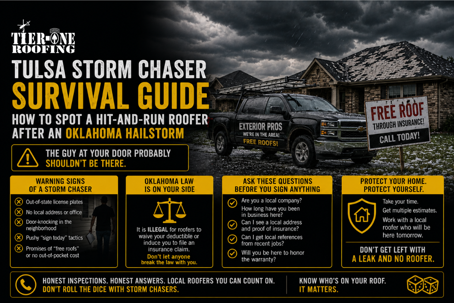
How to Spot a Storm Chaser After an Oklahoma Hailstorm (And Why the Guy at Your Door Probably Should Not Be There)
A hailstorm rolls through Tulsa, Broken Arrow, Bixby, Owasso, or anywhere across the metro. Within hours, the doorbell starts ringing. Crews in branded shirts are walking the neighborhood in pairs, knocking on every door. The pitch is usually some version of the same thing. They were "in the area" doing inspections. They noticed "significant damage" on your roof from the storm. They can get you a "free roof" through your insurance. They just need you to sign a quick form so they can "get the process started" before it is too late.
Almost every part of that pitch is engineered to bypass your judgment. Some parts of it are illegal under Oklahoma law. The rest is structured to lock you into a contract before you have time to think, get other estimates, or check whether the company is actually a real local business that will exist next year.
Storm chasers have been a fixture of Oklahoma's spring storm season for decades, and the playbook has become more sophisticated over time. The crews that show up after a major hail event are not local Tulsa roofers expanding their service hours. They are out-of-state operations that follow storm tracks, set up temporary offices, run aggressive door-knocking campaigns, sign as many contracts as they can in the first 30 to 60 days, do the work fast, and leave town before the warranty issues start showing up.
This is the no-fluff guide to how storm chaser operations work, what Oklahoma law actually says about their tactics, the specific warning signs every Tulsa-area homeowner should recognize, the questions that immediately separate real local roofers from hit-and-run crews, and what to do if you have already signed something you should not have. Tier-One Roofing has been operating in Green Country since 2014 and has watched this play out hundreds of times. Here is what homeowners need to know before the next storm hits.
How Storm Chaser Operations Actually Work
Storm chasing as a business model is built on speed and volume. Understanding the mechanics helps explain why the tactics work and why they target the homeowners they target.
The crews that show up in Tulsa after a hail event are typically employees or commissioned subcontractors of out-of-state roofing companies that maintain a small permanent crew and a much larger pool of mobile sales and installation labor. When a major storm hits an area, the company moves a crew into the affected market within 24 to 72 hours. They rent a temporary office or use a small local presence as a base of operations. They print door-hanger flyers, lawn signs, and branded shirts overnight. They begin door-to-door canvassing immediately, prioritizing neighborhoods with the most visible storm damage and the highest concentration of homes likely to have insurance coverage that supports a claim.
The sales pitch is highly scripted. Crews are trained to use specific language designed to create urgency, establish false credibility, and secure a signature on the spot. The script typically opens with a comment about damage observed from the street, transitions into an offer of a free inspection, and ends with a contract or assignment of benefits document presented as a routine formality.
Once a homeowner signs, the company files an insurance claim on the homeowner's behalf. The claim scope is often inflated to maximize the payout from the insurance carrier. The work is scheduled and completed quickly, sometimes within days of the contract signing, often using subcontracted crews that may not have any direct relationship with the company that signed the contract. The company collects payment from the insurance carrier, sometimes plus an additional payment from the homeowner for non-covered scope items, and moves on to the next storm.
The economic model works because volume covers the customers who later have problems. A storm chaser who signs 200 contracts in a 60-day window after a major storm only needs the bulk of those installations to go smoothly to be profitable. The 10 or 20 homeowners who later discover leaks, warranty problems, or shoddy workmanship are absorbed as a cost of doing business. By the time those issues surface, the company has moved to the next storm market and is operationally unreachable.
This is why "the guy at your door after the storm" is almost never a permanent local Tulsa roofer. Permanent local roofers are responding to existing customer calls, scheduling inspections, and managing their pipeline of work. They are not running door-to-door operations in neighborhoods where they have no existing customer relationships. The crew on your porch is, in nearly every case, working a model that depends on signing you fast and leaving before problems show up.
What Oklahoma Law Actually Says
Oklahoma has specific laws designed to protect homeowners from the most common storm chaser tactics. Knowing what the law says is the first line of defense.
Deductible-eating is illegal. Since 2022, Oklahoma House Bill 1940 has made it illegal for any roofing contractor or third-party company to waive, absorb, pay, rebate, or in any way diminish a homeowner's insurance deductible when replacing a roof as part of an insurance claim. This is not a guideline or a suggestion. It is state law. Any contractor offering to "pay your deductible," "make your deductible disappear," "rebate it back to you," "absorb it into the bid," or any similar arrangement is breaking Oklahoma law. The contractor faces legal consequences. The homeowner who knowingly participates can also face exposure for insurance fraud, which can void the claim, trigger non-renewal of the policy, and in extreme cases result in criminal liability.
When a contractor opens with "we'll cover your deductible" or "free roof, no out-of-pocket cost," the only correct response is to ask them to leave. They have already shown you that they are willing to break Oklahoma law to earn your business, which tells you everything you need to know about how they will handle every other aspect of the project.
Right to cancel. Under Oklahoma's residential consumer protection laws, homeowners typically have the right to cancel a contract for home repair services within three business days of signing, especially when the contract was solicited at the home (door-to-door) rather than at the contractor's place of business. The exact application varies by circumstance, but the protection exists for a reason. If you signed something at your door under pressure and now have second thoughts, you may have legal options to back out.
Licensing requirements. Oklahoma requires roofing contractors to be registered with the Oklahoma Construction Industries Board (CIB). The CIB maintains a public database where homeowners can verify that a contractor is properly registered. Operating as a roofing contractor in Oklahoma without proper CIB registration is a violation of state law. Storm chasers from out of state sometimes operate without proper Oklahoma registration, which exposes the homeowner to risk if anything goes wrong because the contractor has no legal standing in the state.
Tier-One Roofing's Oklahoma license number 80002404 is published openly on every page of the company website, which is what compliant contractors do. If you cannot easily find a license number for the contractor at your door, that is a problem.
Assignment of Benefits and contract complexity. Many storm chaser contracts include an Assignment of Benefits (AOB) clause that transfers the homeowner's right to negotiate with the insurance carrier directly to the contractor. AOB contracts can be legitimate in some situations, but they are also frequently used to lock homeowners into arrangements where the contractor controls the entire claim process. Once you sign an AOB, the contractor can negotiate with your carrier, agree to settlement amounts, and direct the work scope without needing further input from you. Read any contract carefully before signing, and understand specifically whether you are assigning your rights under the policy.
Insurance fraud is prosecuted in Oklahoma. Insurance carriers operating in Oklahoma have full claims investigation units and active relationships with state and federal law enforcement on fraud cases. Inflated claims, fabricated damage, and contractor-driven claim padding are all investigated regularly. The contractor who tells you they will "make sure the claim covers everything plus your deductible" is asking you to participate in fraud. If the fraud is discovered, the contractor disappears and the homeowner faces the consequences.
The 12 Warning Signs of a Storm Chaser
Knowing the patterns is the fastest way to identify a problem before you sign anything. Here are the specific warning signs every Tulsa-area homeowner should recognize.
Sign one: They knocked on your door uninvited after a storm. Permanent local roofers do not run door-to-door campaigns. The crew on your porch is almost certainly storm chaser by definition.
Sign two: They claim to have noticed damage on your roof from the street. Significant roof damage often is not visible from the ground even to trained roofers. A claim of street-level diagnosis is either dishonest or based on assumption rather than inspection.
Sign three: They offer to pay your deductible or eliminate your out-of-pocket cost. This is illegal under Oklahoma House Bill 1940. Any contractor making this offer is breaking state law.
Sign four: They pressure you to sign on the spot. Legitimate roofing decisions involve multiple estimates, time to verify the contractor, and consultation with your insurance carrier. Pressure to sign immediately is designed to bypass your due diligence.
Sign five: They tell you their pricing is "only available today" or that the offer "expires in 24 hours." This is a manipulation tactic. Real roofing pricing does not expire on a 24-hour cycle.
Sign six: They cannot give you their Oklahoma CIB license number on the spot. Registered contractors know their license number and have it on their truck, business card, and contract paperwork. Hesitation here is a problem.
Sign seven: Their physical office address is unverifiable, out of state, or a UPS Store box. A real local contractor has a real local office where you can drive to meet someone.
Sign eight: Their phone number is a national 800 number or rings to a call center. Permanent local roofers have local phone numbers that ring to local people.
Sign nine: They want you to sign an Assignment of Benefits before any work scope is determined. AOBs handed to homeowners during the first conversation are red flags. Legitimate roofing relationships do not need AOBs to function.
Sign ten: They cannot provide local references from completed Tulsa-area projects. Three to five recent local references should be available on request from any legitimate contractor. If they cannot provide them, they have not done meaningful work in this market.
Sign eleven: Their reviews online are recent, generic, and concentrated on a few platforms. Storm chasers often use reputation management services that generate batches of similar-sounding positive reviews on Google, BBB, or Facebook profiles that are only a few months old. Look for review depth, age, and specificity.
Sign twelve: Something about the conversation just feels off. Your gut is usually right. If a salesperson is being too aggressive, too smooth, too eager to close, or too vague about specifics, those instincts are telling you something. Trust them.
When you see two or more of these signs in the same conversation, the right move is to politely end the interaction and call a permanent local roofer for an independent assessment.
Just had a storm hit your area? Skip the door-knockers and call a permanent local team. Tier-One Roofing offers free, no-pressure storm damage inspections across the Tulsa metro and Oklahoma City metro. 918-393-4682 in Tulsa, 405-458-8656 in OKC, or book online at tier-oneroofing.com.
Questions That Separate Real Roofers From Storm Chasers Immediately
If you are unsure about the contractor at your door, the questions below will surface the truth quickly. A legitimate local roofer will have ready answers to all of these. A storm chaser will hesitate, deflect, or get visibly uncomfortable.
What is your Oklahoma Construction Industries Board license number? They should be able to tell you on the spot, and you should be able to verify it through the CIB's public database before any contract is signed.
What is the physical address of your permanent office in Oklahoma, and how long have you been operating from that address? They should give you a real address where you can drive to meet someone, and they should have been at that address for years rather than weeks or months.
Can I call three of your recent customers in this area for references? They should be able to provide local references quickly. Storm chasers either cannot provide them or provide references that ring to other crew members.
What is your workmanship warranty in writing, and how long is it? Legitimate workmanship warranties run from 5 to 25 years depending on the contractor. They should be in writing as part of the contract, not verbal promises.
If something goes wrong with this roof in three years, what is the process for getting it addressed? Listen carefully to the answer. Real local roofers have a clear answer involving their permanent local office. Storm chasers get vague.
Are you offering to pay or absorb my insurance deductible in any way? If the answer is yes, the conversation is over. They have just admitted to breaking Oklahoma law.
How will you handle communication with my insurance adjuster? Legitimate contractors will offer to be present at the adjuster walkthrough and document damage thoroughly. Storm chasers often want to control the entire claim process through an AOB.
What is your specific scope of work for my home, and can I see the line items in writing? They should be able to provide a written estimate breaking out tear-off, underlayment, ice and water shield, drip edge, flashing, shingles, ridge vents, ridge caps, permits, and labor. A single-line estimate is a problem.
Can you walk me through your installation specifications? Things like nail pattern (six nails per shingle is the right answer), underlayment type (synthetic, not felt), ice and water shield placement (valleys and eaves), and flashing approach (new flashing, not reused). Real roofers are happy to talk specifications. Storm chasers often cannot.
What happens if my insurance claim is denied or comes in lower than your bid? Their answer reveals whether they have a legitimate process or whether the entire economic model depends on the insurance check arriving exactly as projected.
When a contractor cannot answer these questions confidently and specifically, you are not talking to a permanent local roofer. You are talking to someone working an out-of-state script.
What to Do If You Have Already Signed
If you signed a contract with a storm chaser and now have second thoughts, you may have options. The first thing to do is take a breath and stop additional work or actions until you understand your position.
Read the contract you signed carefully. Look specifically for cancellation provisions, the contractor's actual identity (not just the brand on the truck), the workmanship warranty terms, and any AOB language. Take photos of the entire contract.
If you signed within the last three business days and the contract was solicited at your home, you may have a right to cancel under Oklahoma's home solicitation sales protections. Cancellation typically requires written notice within the cancellation window. Send the notice via certified mail or another method that creates documentation.
If you have already had work done but suspect the work was substandard or the contractor was not legitimate, document everything. Photograph all visible work. Save all communication, contracts, and payment records. Get an independent inspection from a local Tulsa roofer to assess the quality of the installation.
If the contractor offered to absorb your deductible or otherwise asked you to participate in something that may have been insurance fraud, talk to your insurance carrier and consider consulting an attorney before taking further action. Self-reporting potential fraud through proper channels is generally better than waiting for the carrier to discover it independently.
If the contractor disappears or becomes unreachable after taking your money or signing the contract, file a complaint with the Oklahoma Attorney General's Consumer Protection Unit and the Oklahoma Construction Industries Board. Both agencies investigate consumer complaints against contractors operating in the state.
If your AOB has been used to negotiate with your insurance carrier in ways you did not authorize, contact your carrier directly to understand what has been done and what your options are. Many carriers have specific provisions for handling AOB disputes.
The general principle is to document everything, act quickly within available cancellation windows, and consult with appropriate authorities or counsel when the situation has gone beyond what you can resolve directly. Permanent local contractors can also help assess what has been done and what needs to be redone, even if you originally signed with someone else.
What Real Local Roofers Do Differently
The contrast between storm chasers and permanent local roofers becomes obvious once you know what to look for. Real local roofers operate fundamentally differently in ways that show up at every stage of the relationship.
Real local roofers do not knock on doors after storms. They respond to inbound calls, referrals, and existing customer relationships. The marketing model is built on long-term reputation rather than 60-day storm windows.
Real local roofers tell you when you do not need a roof. The financial incentive structure for an honest local roofer favors long-term relationships and referrals, which means telling a homeowner that their roof has more life left and does not need replacement is sometimes the right answer. Storm chasers cannot afford to walk away from a sale.
Real local roofers educate you about the process. They explain what storm damage looks like, what insurance claims involve, what installation specifications matter, and what the trade-offs between options actually are. The conversation is consultative rather than transactional.
Real local roofers stand behind warranties because they will be around to honor them. A 10-year workmanship warranty from a contractor with a permanent Tulsa office and an Oklahoma license is a real warranty. The same warranty from an out-of-state operation is worth approximately nothing.
Real local roofers welcome questions about their license, references, address, and specifications. There is nothing to hide because the operation is built on legitimate credentials. Hesitation about any of these basics is a signal in itself.
Real local roofers are not in a hurry. Quality work takes time. Quality decision-making takes time. A contractor who is willing to give you the time to think, get other estimates, and verify their credentials is showing you who they are.
Real local roofers participate in the local community. They are members of the Greater Tulsa Association of Realtors, the Tulsa Regional Chamber, local Better Business Bureau chapters, and similar organizations. They sponsor local events and participate in local causes. They show up at the same coffee shops and ballgames as their customers.
Tier-One Roofing has operated this way since the company was founded in 2014. The company is a proud sponsor of the Wounded Warrior Project and Soldiers Wish Foundation. The team participates in local community events and supports causes connected to the veteran community. The standards that apply to the actual roofing work also apply to how the company shows up in Tulsa-area neighborhoods.
Why Tier-One Roofing Is the Anti-Storm-Chaser
Everything about how Tier-One Roofing operates is the opposite of how storm chasers operate. The contrast is not accidental, it is intentional.
The company is veteran-owned and operated. Founder Jonathan Marsh is a US Army Ranger, Blackhawk pilot, and combat veteran who built Tier-One Roofing on a no-shortcuts standard borrowed from his military background. The team operates with the kind of accountability and follow-through that the military trains into its people.
The Oklahoma Construction Industries Board license number 80002404 is published openly on every page of the company website. Verification is encouraged. Hiding nothing is the default.
The permanent office at 2013 South Elm Place in Broken Arrow has been the company's address for years. Driving by it is encouraged. Walking in unannounced is welcome. There is no temporary trailer in a parking lot, no UPS Store mailbox, no out-of-state ownership.
The phone numbers ring to real people. 918-393-4682 in Tulsa. 405-458-8656 in Oklahoma City. The same numbers will ring to the same team five and ten years from now.
The team is FORTIFIED-certified for the Oklahoma Strengthen Oklahoma Homes grant program, experienced with VA grant project work for disabled veterans, and capable of handling everything from simple repair jobs to full insurance claim restorations to specialized adapted housing projects. The expertise is wide and deep because the company has been here long enough to develop both.
The estimates are line-itemed in writing. The workmanship warranties are documented in writing. The insurance claim process is handled with adjuster coordination and full transparency. The deductible is the homeowner's responsibility and that is communicated up front, because Oklahoma law requires it and because honest business practice requires it.
The service area covers Tulsa, Broken Arrow, Bixby, Owasso, Jenks, Sand Springs, Sapulpa, Glenpool, Collinsville, Skiatook, Claremore, Verdigris, Inola, Catoosa, Coweta, Mounds, Muskogee, Okmulgee, Grove, Grand Lake, Bernice, Sperry, Jay, Langley, and the broader Oklahoma City metro. Services include roof repair, roof leak repair, full installations across asphalt and metal, roof inspections, roof maintenance, roof coatings, storm damage restoration, gutter repair and installation, the full insurance claims process, FORTIFIED roof installations under the SOH grant program, and VA grant project work.
Storm chasers exist because a fast-moving, high-pressure model can extract a lot of money from homeowners in the immediate aftermath of a storm. The way to defeat that model in your own neighborhood is to skip the door-knockers entirely, refuse to engage with anyone using the warning signs above, and call a permanent local roofer who has been here long enough to be accountable.
That is what Tier-One Roofing has built. The next storm is coming. When it does, the right call is to a contractor who will still be here to take your call after the storm chasers have left town.
Skip the door-knockers. Call Tier-One Roofing for honest, no-pressure storm damage inspections, transparent estimates, and roofing work backed by a contractor who has been in Broken Arrow since 2014 and is not going anywhere. Tulsa: 918-393-4682. Oklahoma City: 405-458-8656. Online at tier-oneroofing.com. The inspection is free. The advice is straight. The work stands the test of Oklahoma weather and time.