
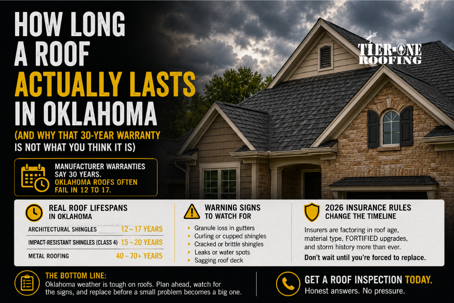
How Long a Roof Actually Lasts in Oklahoma (And Why That 30-Year Warranty Is Not What You Think It Is)
Walk into any big-box home improvement store and look at the asphalt shingles on display. Most of them carry warranty stickers proudly advertising 25-year, 30-year, even lifetime coverage. The implication is obvious: buy this shingle, install it on your house, and you will not need to think about your roof again for three decades.
That is not how it works in Oklahoma.
The actual lifespan of an asphalt shingle roof in the Tulsa metro and Oklahoma City metro is meaningfully shorter than the manufacturer warranty suggests. Hail keeps coming. UV exposure keeps degrading the asphalt mat. Thermal cycling keeps stressing the shingles. Wind events keep breaking sealant strips. By the time a shingle warranty hits its midpoint, a typical Oklahoma roof has already been replaced once and is approaching the end of its second life.
This is the no-fluff guide to how long roofs actually last in Oklahoma conditions, the warning signs to watch for at each stage of a roof's life, what factors push lifespan longer or shorter, when to start budgeting for replacement, and how the new 2026 Oklahoma insurance rules around roof age and FORTIFIED upgrades change the timing of when you should replace.
Tier-One Roofing has been replacing roofs across Green Country since 2014. The team has watched plenty of Oklahoma homes go through the full cycle from new roof to first replacement to second replacement. Here is what the timeline actually looks like.
The Real Lifespan of an Asphalt Shingle Roof in Oklahoma
Manufacturer warranties for architectural asphalt shingles typically run 25 to 30 years, with some premium products carrying 50-year or "lifetime" warranties. Those numbers are based on testing in controlled conditions and represent the manufacturer's confidence that the product itself will not fail prematurely from manufacturing defects.
What those warranties do not account for is Oklahoma weather.
The realistic average lifespan of a quality architectural asphalt shingle roof in the Tulsa metro is 12 to 17 years. Some roofs make it past that. Some fail well before. The bell curve centers around the 14 to 15 year mark for a typical home in a typical Tulsa neighborhood with typical exposure to Oklahoma's storm patterns.
That gap between warranty and reality has several causes. The Tulsa metro averages roughly five hail days per year, which is significantly above the national average. Each meaningful hail event accelerates shingle aging by bruising the asphalt mat, fracturing the granule bed, and breaking sealant strips. Multiple events compound. A roof that has been through three or four moderate hail events over its first decade is functionally older than a roof of the same age in a region without that hail exposure. UV exposure in Oklahoma's hot summers degrades the asphalt mat and bleaches the granules. South-facing and west-facing slopes typically age faster than north-facing slopes for this reason. Thermal cycling, where the roof temperature swings 60 to 80 degrees between day and night during summer and shoulder seasons, expands and contracts the shingles repeatedly and creates stress that accumulates over time. Wind events break sealant strips that bond shingles together, which can leave shingles structurally intact but functionally compromised.
When manufacturer warranty math meets Oklahoma weather, the warranty wins on paper and the weather wins in reality.
For three-tab shingles, which carry shorter warranties to begin with and are dramatically less wind-resistant than architectural shingles, the realistic Oklahoma lifespan is even shorter, often 8 to 12 years. This is part of why three-tab shingles are not recommended for Oklahoma installations even when the upfront cost looks attractive.
For Class 4 impact-resistant shingles, which are tested to withstand significantly larger hail without damage, the realistic Oklahoma lifespan is 18 to 25 years, meaningfully closer to the manufacturer warranty. The upgrade pays for itself across the extended lifespan plus the insurance premium discounts most Oklahoma carriers offer on Class 4 installations.
For FORTIFIED-rated installations meeting the IBHS Hail Impact standard, lifespan extends further still, with the added benefit of the Oklahoma Strengthen Oklahoma Homes grant of up to $10,000 toward installation cost and wind insurance premium discounts up to 42 percent.
The Real Lifespan of a Metal Roof in Oklahoma
Metal roofing operates on a fundamentally different lifespan curve than asphalt.
A quality standing seam metal roof in 24-gauge with a premium painted finish realistically lasts 40 to 60 years in Oklahoma conditions. The painted finish typically carries a 30-year to 40-year color warranty, after which the panels may need refinishing or repainting but the underlying metal remains structurally sound. The system itself can outlast the original homeowner without needing replacement.
Stone-coated steel panels typically last 40 to 50 years. The granular textured surface holds up well to UV and weathering, and the panel profile resists wind uplift effectively.
Exposed fastener metal panels last 30 to 40 years if maintained, with the neoprene gaskets around fasteners typically needing inspection and selective replacement every 10 to 15 years to prevent leaks at fastener penetrations.
The hail consideration for metal is different than for asphalt. Metal does not develop the granule loss and shingle bruising patterns that age asphalt prematurely. Metal can dent under severe hail, but the structural integrity and watertight performance are typically not compromised by cosmetic damage. The result is that metal roofing in Oklahoma generally delivers a much longer lifespan with fewer interim repair needs, even though the upfront cost premium is meaningful.
For homeowners running the long-term cost math, the lifespan advantage of metal is the primary argument. A homeowner who installs a quality standing seam roof at age 40 may not need another roof in their lifetime, where the same homeowner installing asphalt would face two or three more roof replacements over the same timeframe.
Warning Signs at Each Stage of an Asphalt Roof's Life
Oklahoma homeowners benefit from knowing what to expect from their roof at each phase of its lifespan. Warning signs vary by stage, and understanding the progression helps with planning.
Years 1 to 5: New roof phase. A properly installed asphalt roof should show essentially no warning signs during the first five years. The shingles should still have their full granule coverage, the sealant strips should be intact, and there should be no nail pops, lifted shingles, or visible aging. The only events that should trigger concern during this phase are storm events. After any significant hail or wind event, even on a new roof, a professional inspection is the right move because hail damage in years 1 to 3 is often misattributed to manufacturing defect when it is actually storm damage that should be filed against insurance. Documentation matters during this phase. Keep records of the installation date, the contractor, the manufacturer warranty registration, and any inspection reports.
Years 5 to 10: Mid-life phase. During this phase, normal weathering becomes visible but the roof should still have plenty of life. Granule color may fade slightly, particularly on south and west-facing slopes. A small amount of granule loss in gutters is normal. The roof should still be watertight, the sealant strips should still be holding, and there should be no widespread visible damage. Storm events during this phase are when most Oklahoma roofs accumulate the damage that determines whether they reach the upper end of their lifespan or fail early. Annual or biannual professional inspections during this phase are inexpensive insurance against undetected damage that compounds over time.
Years 10 to 15: Aging phase. This is the phase where Oklahoma roofs start showing meaningful wear. Granule loss accelerates and becomes more visible in gutters and at downspout outlets. Some shingles may show curling at the edges, particularly on slopes with the most sun exposure. Nail pops begin to appear randomly. Sealant strips may have failed in spots, allowing wind to lift shingles even without tearing them off. The flashing around chimneys, vents, and skylights starts showing its age, with sealant deterioration and minor gaps developing. During this phase, the question shifts from "does my roof need attention" to "how long can I reasonably expect to keep this roof going." The answer depends heavily on storm exposure, original installation quality, and the specific shingle product. A documented professional inspection during this phase is increasingly important, both for maintenance planning and for the new 2026 Oklahoma insurance protections that require an inspection showing five years of remaining useful life to prevent age-based non-renewal.
Years 15 and beyond: End-of-life phase. Most Oklahoma asphalt roofs reach functional end of life somewhere between year 12 and year 17, though some make it longer. Warning signs during this phase include widespread granule loss across the entire roof, multiple curled or buckled shingles, missing shingles in increasing numbers, daylight visible through the roof when looking up from the attic, sagging spots that may indicate decking deterioration, multiple leaks or repeated leaks in different locations, and visible degradation of flashing across multiple penetrations. When a roof shows three or more of these signs simultaneously, it is past the point of effective spot repair and should be replaced. Continuing to invest in repairs on a roof in this condition is throwing money at a problem that will not stop generating repair calls until the roof is replaced.
What Pushes Roof Lifespan Longer or Shorter
The bell curve has tails. Some Oklahoma roofs make it well past 17 years. Some fail well before 12. The factors that determine where a specific roof lands within the range are predictable.
Original installation quality is the largest factor. A roof installed by a quality contractor with proper underlayment, proper nail pattern (six nails per shingle, not four), proper flashing details, proper ventilation, and proper attention to the small things will outlast a roof installed by a budget contractor or storm chaser by several years even with identical material and equivalent storm exposure. The fastest way to shorten a roof's lifespan is to install it cheaply.
Storm exposure matters significantly. A roof in a Tulsa neighborhood that has been hit by three significant hail events in its first decade is aging faster than a roof in a neighborhood that has had storms pass to the north or south. Microclimate variation across the metro is real, and storm tracks affect specific neighborhoods more than others. There is no controlling for this beyond installing more durable materials in the first place.
Slope direction matters. South and west-facing slopes age faster than north-facing slopes due to UV exposure. On a roof with multiple slopes, the south and west-facing portions often need attention before the north-facing portions, and full replacement is the right answer when the most-exposed slopes have aged out even if other slopes still have life left.
Attic ventilation matters more than most homeowners realize. A roof installed over an inadequately ventilated attic ages faster because heat and moisture accumulate under the decking, accelerating shingle deterioration from below. Proper ridge vent and soffit vent balance is part of every quality roof installation, and homes with inadequate ventilation can extend roof life meaningfully by correcting it.
Tree exposure has a complicated effect. Trees that shade portions of the roof reduce UV aging, which extends shingle life. Trees that drop debris, branches, and acorns onto the roof accelerate damage to shingles in physical contact zones. Trees that allow squirrels and other animals direct roof access can create chewed flashing and torn shingles. Net effect varies by specific tree placement.
Material choice matters at the upgrade level. Architectural shingles outlast three-tab shingles meaningfully. Class 4 impact-resistant shingles outlast standard architectural shingles. FORTIFIED-rated installations outlast standard Class 4 installations. Metal outlasts all asphalt options. Each upgrade extends the realistic Oklahoma lifespan and shifts the long-term cost math.
Maintenance matters at the margin. Annual gutter cleaning, periodic inspection, prompt repair of small issues like cracked pipe boots and lifted shingles, and proactive flashing maintenance can add years to a roof's functional life. Deferred maintenance accelerates failure. The math on roof maintenance is straightforward: a $200 to $400 annual investment in inspection and minor repairs typically extends roof life by two to four years, which is worth thousands compared to early replacement.
How the 2026 Oklahoma Insurance Rules Change Roof Timing
The Oklahoma Insurance Department's 2026 reforms changed the calculation around when to replace a roof, particularly for homeowners with roofs approaching the 15-year mark.
Under the previous landscape, Oklahoma carriers could non-renew or refuse to issue homeowners insurance based solely on roof age. A 16-year-old roof in good condition could trigger automatic non-renewal even when the roof had years of useful life remaining. This created a quiet pressure to replace roofs prematurely, before the carrier dropped coverage, even when the roof was still performing.
The 2026 reforms changed this. Insurers can no longer non-renew, refuse coverage, or reduce coverage based solely on a roof being 15 years or older. Homeowners now have the right to obtain an independent inspection showing that the roof has at least five years of useful life remaining, and the carrier cannot use age alone as a reason to drop the policy.
This changes the timing calculation in several ways.
For homeowners with roofs in the 12 to 17 year range that are still performing, getting a documented professional inspection on file becomes legally protective. A signed inspection report from a licensed contractor showing remaining useful life keeps coverage in place and protects against age-based non-renewal. The cost of the inspection is small compared to the value of the protection.
For homeowners with roofs that genuinely need replacement, the 2026 environment creates an opportunity to plan the replacement on your terms rather than scrambling after a leak. The Strengthen Oklahoma Homes grant program provides up to $10,000 toward FORTIFIED roof installations, which is most accessible to homeowners who plan ahead rather than react to an emergency.
For homeowners considering whether to file an insurance claim on storm damage, the 2026 reforms tightened claim timelines but also clarified the rules around documentation. Working with a contractor who understands the new claim process is more important than ever.
For homeowners shopping insurance, the 2026 environment rewards homes built or upgraded to FORTIFIED standards with significant premium discounts that compound over time. Combined with the SOH grant, the path to a more durable roof at lower out-of-pocket cost is genuinely accessible.
The bottom line is that the right time to replace your roof is no longer purely about whether the roof has failed. It is about a more nuanced calculation involving roof condition, insurance coverage status, available grant funding, and long-term cost optimization. Working through that calculation with a knowledgeable local contractor is increasingly valuable.
Schedule a free roof condition assessment with Tier-One Roofing to find out where your roof actually stands. Tulsa: 918-393-4682. Oklahoma City: 405-458-8656. Online booking at tier-oneroofing.com. The inspection is free, the report is documented, and the recommendations are honest.
When to Start Budgeting for Replacement
Most Oklahoma homeowners do not budget proactively for roof replacement until they are already dealing with leaks or storm damage. That is the most expensive way to handle the eventual replacement, because it eliminates the ability to plan, shop, and time the work.
A better approach starts the budgeting conversation earlier in the roof's life, ideally during the year 10 to 12 window for an asphalt roof. At that point, the roof is in the second half of its functional life, the lifespan range starts to get more predictable, and there is enough runway to plan the financial side of the eventual replacement.
The rough budget framework for a typical Tulsa-area home looks like this. For architectural asphalt shingle replacement on an average 2,000 square foot roof, expect $9,000 to $13,000 in 2026 dollars. For Class 4 impact-resistant asphalt, add $1 to $2 per square foot, putting the total at $11,000 to $17,000. For metal, expect $16,000 to $24,000 depending on the system. For FORTIFIED-rated installations under the SOH grant program, the grant of up to $10,000 reduces the out-of-pocket cost meaningfully.
Setting aside $2,000 to $3,000 per year starting at year 10 builds a meaningful replacement fund by the time the roof actually needs replacement. For homeowners who prefer not to self-fund, financing options including home improvement loans, HELOCs, and contractor financing partnerships are available at competitive rates.
The other budgeting question is when to consider proactive replacement before the roof has fully failed. The honest answer depends on the specific situation, but several scenarios make proactive replacement financially smart.
When the roof is at year 13 to 15 with visible aging signs and the homeowner plans to stay in the home long-term, proactive replacement allows the homeowner to choose timing, contractor, and material on their terms rather than being forced to react.
When the SOH grant funding cycle is open and the homeowner qualifies, proactive replacement to FORTIFIED standards captures up to $10,000 in grant funding that may not be available later if program funding runs out.
When the homeowner is preparing to sell within two to three years, proactive replacement before listing typically delivers more resale value than the same project done after the home is on the market and discovered during inspection.
When the homeowner has experienced a storm event but the damage is borderline for an insurance claim, getting a professional assessment before the claim deadline expires preserves the option to file if the contractor's documentation supports it.
When deferred maintenance has accumulated and individual repairs are stacking up faster than they are being completed, replacement is often more cost-effective than continuing to chase repairs.
The framing matters: a roof replacement at the right time, with the right material, by the right contractor, is an investment that pays back across the next 15 to 50 years. A roof replacement done in panic after a major leak, with whatever contractor is available fastest, with whatever material is in stock, is an expense that often delivers a worse result for more money.
When to Stop Repairing and Replace
The flip side of the budgeting question is the repair-or-replace decision when an aging roof starts generating service calls.
The general rule is that when repair costs exceed roughly 30 to 40 percent of replacement cost across a 12-month period, replacement is the better economic choice. A roof that needs $1,500 in repairs in one year, on a home where replacement would cost $11,000, is approaching the break-even point. A second year of similar repair spending almost certainly tips the math toward replacement.
The other indicators that signal stop-repairing-start-replacing include multiple repair attempts in the same area without long-term resolution, repair work needing to be done on aging shingles that the contractor cannot match in color or product line, leak frequency increasing rather than decreasing despite repair attempts, and the contractor's professional judgment that the roof is past the point of effective spot repair.
Honest contractors will tell you when continued repair is throwing money at a roof that needs replacement. Less honest contractors will keep taking the repair work because each individual repair is profitable for them even when it is bad value for you. This is one of the places where contractor selection matters meaningfully.
Why Tier-One Roofing for Lifespan Assessments and Replacement Planning
Roof lifespan assessment is a different skill set than installation work. The contractor doing the assessment needs to understand Oklahoma weather patterns, the specific aging signatures of different shingle products, the implications of the new 2026 insurance environment, the SOH grant program, the FORTIFIED standard, and the financing options available to homeowners. Most importantly, the contractor needs the integrity to tell you accurately where your roof actually stands rather than always recommending replacement to drive sales.
Tier-One Roofing has been doing this assessment work across the Tulsa metro and Oklahoma City metro since 2014. Founder Jonathan Marsh is a US Army Ranger, Blackhawk pilot, and combat veteran who built the company on a no-shortcuts standard that applies to every interaction, including the free inspections that result in a recommendation to keep the existing roof going for another few years. The team is FORTIFIED-certified for the SOH grant program, experienced with VA grant project work for disabled veterans, and a proud sponsor of the Wounded Warrior Project and Soldiers Wish Foundation.
The company operates from a permanent Broken Arrow office at 2013 South Elm Place. Oklahoma license number 80002404 is published openly and verifiable through the Oklahoma Construction Industries Board. The phone numbers ring to real people, the inspections are free, the reports are documented in writing, and the recommendations are honest about whether your roof needs replacement now, in a few years, or not for a long time.
The service area covers Tulsa, Broken Arrow, Bixby, Owasso, Jenks, Sand Springs, Sapulpa, Glenpool, Collinsville, Skiatook, Claremore, Verdigris, Inola, Catoosa, Coweta, Mounds, Muskogee, Okmulgee, Grove, Grand Lake, Bernice, Sperry, Jay, Langley, and the broader Oklahoma City metro. Services include roof repair, roof leak repair, full installations across asphalt and metal, roof inspections and lifespan assessments, roof maintenance, roof coatings, storm damage restoration, gutter repair and installation, the full insurance claims process, FORTIFIED roof installations under the Oklahoma Strengthen Oklahoma Homes grant program, and VA grant project work for disabled veterans.
If you are at any point in the roof lifespan curve, from new construction to pushing the limits at year 18, and you want a professional assessment of where your roof actually stands and what the smart next move looks like, Tier-One Roofing is the right call.
Find out how much life your roof has left. Book a free professional roof condition assessment with Tier-One Roofing at tier-oneroofing.com, or call 918-393-4682 in Tulsa or 405-458-8656 in OKC. Documented inspection reports, honest recommendations, and a contractor who has been here since 2014 and will still be here when your next roof goes on.