
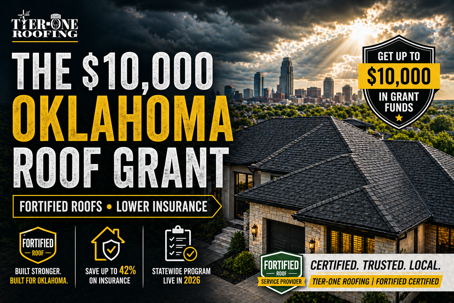
There is a state program right now in Oklahoma that will pay up to $10,000 directly to your roofing contractor to upgrade your home to a storm-resistant FORTIFIED roof, can cut your wind insurance premium by as much as 42%, and is saving pilot program participants an average of $750 per year. The program went statewide on January 12, 2026. Most Tulsa homeowners have never heard of it. The ones who have, often think it sounds too good to be true.
It is not too good to be true. It is the Strengthen Oklahoma Homes (SOH) program, run by the Oklahoma Insurance Department under the OKReady initiative, and it is one of the most homeowner-friendly programs this state has ever launched. The catch, if there is one, is that the new 2025 FORTIFIED standards require the work to be done by a roofer who is actually trained and certified as a FORTIFIED service provider. That list is short. In Tulsa, Jonathan Marsh, the owner of Tier-One Roofing, is on it.
This is the no-fluff breakdown of what the FORTIFIED program is, what the grant covers, how it actually saves you money, what makes a FORTIFIED roof technically different from a standard roof, and how to take advantage of all of it before grant funds run out. Tier-One Roofing has been working in this space long enough to walk every homeowner through it personally, but you should understand the program first so you know exactly what you are signing up for.
What the FORTIFIED Program Actually Is
FORTIFIED is a voluntary construction and re-roofing standard developed by the Insurance Institute for Business and Home Safety (IBHS) after decades of research into how homes actually fail in severe weather. Approximately 70,000 properties across 31 states have now been built or re-roofed to FORTIFIED standards. The program is built on the simple observation that most catastrophic home damage starts with the roof. Wind gets under an edge, peels back the covering, exposes the deck, water gets in, and a roof problem turns into a whole-house problem in a single afternoon.
The FORTIFIED Roof standard fixes the weak points in a typical roof installation through specific, measurable upgrades. There are three progressive levels in the program. FORTIFIED Roof is the entry level and is the focus of Oklahoma's grant program. Above that are FORTIFIED Silver and FORTIFIED Gold, each adding more whole-home protection.
For Oklahoma, the standard adopted by the state is the FORTIFIED Home Roof High Wind designation with the Hail Supplement. That mouthful matters. The High Wind portion strengthens the roof against the kind of sustained winds and gusts Oklahoma sees during severe thunderstorms and tornadoes. The Hail Supplement adds requirements specifically built around resistance to hail up to two inches in diameter, which is exactly the size category that does most of the damage to Tulsa-area roofs every spring. Homes built to this standard have shown to be durable in winds up to EF-2 levels and against hail up to two inches.
In plain English: it is a roof system designed to actually survive Oklahoma weather instead of getting torn off and replaced every five to seven years.
What the Strengthen Oklahoma Homes Grant Pays For and How Much You Save
The Oklahoma Insurance Department launched the SOH grant program out of a simple piece of math. Oklahoma is one of the most storm-prone states in the country. Insurance carriers have been raising rates, dropping policies, and shifting more of the storm risk back onto homeowners. The state's options were limited: keep watching premiums climb until working families could no longer afford coverage, or invest in making homes resilient enough that the carriers had a reason to lower rates again. The SOH program is the second option.
Here is what the grant covers and how the money flows. Eligible Oklahoma homeowners can receive grants of up to $10,000 to upgrade their roofs to the FORTIFIED Home Roof High Wind designation with the Hail Supplement. The funds are paid directly to the contractor after the work is completed and the home receives its IBHS FORTIFIED certification. If the total project cost exceeds the grant amount, the homeowner is responsible for the difference, but you are not required to pay anything up front for the construction work itself. The contract for the work is between you and the contractor.
The savings on the back end are where the real story lives. According to the Oklahoma Insurance Department, FORTIFIED upgrades can reduce severe storm damage by up to 80 percent while lowering homeowners insurance premiums by 20 to 30 percent. Some Oklahoma carriers offer wind premium discounts as high as 42 percent on FORTIFIED-designated homes. Pilot program participants in Oklahoma are saving an average of $750 per year on insurance premiums. Over a 10-year period, that is $7,500 in cumulative savings before you even factor in the reduced risk of having to file a claim or the higher resale value of a FORTIFIED home.
There is a research-backed real estate component too. A University of Alabama study found that FORTIFIED homes sell for roughly 7 percent more than non-FORTIFIED homes. On a typical Tulsa-area home, that is real money at closing.
The pilot phase that ran before the statewide launch helped more than 100 Oklahoma homeowners upgrade their roofs in approved zip codes, with the Oklahoma Insurance Department investing more than $1 million in the program. The 100th FORTIFIED designation funded by the program was recently celebrated by IBHS as a model for what state-level resilience programs can accomplish. The statewide expansion is the result of that pilot working exactly the way it was designed to.
If your roof is at the end of its useful life, or if you have storm damage you are about to file a claim on, this is the moment to look hard at FORTIFIED. Tier-One Roofing offers free consultations for homeowners considering the SOH grant program. Call 918-393-4682 in Tulsa or 405-458-8656 in Oklahoma City, or visit tier-oneroofing.com to schedule a no-pressure walk-through with our team.
Who Qualifies and How to Apply
The statewide program opened to all 77 Oklahoma counties on January 12, 2026 at noon Central, after three pilot phases proved the model out. Grants are awarded on a first-come, first-served basis as funding allows, which means timing matters. Homeowners who get their paperwork together early and move fast will be the ones who actually get funded.
To qualify under the current program rules, your home must be your primary residence and a single-family home in good repair. Mobile homes, manufactured homes, condos, and duplexes are not eligible. You must have an active homeowners insurance policy that includes wind coverage, and an in-force flood insurance policy if your home is in a designated flood hazard area. You must have a homestead exemption on file with your county assessor. The application also requires income verification and your insurance declaration pages.
The application process moves through a few clear steps:
You apply directly through the Oklahoma Insurance Department's grant portal at oid.ok.gov/okready. The first step is creating a profile and submitting the basic application, then uploading your supporting documents.
Once approved, you select a certified FORTIFIED Evaluator from the program's approved list. The evaluator performs an initial inspection to determine whether your home is eligible to be upgraded to the FORTIFIED Roof standard and documents the scope of work needed. The evaluator's fee is paid by you directly to the evaluator and is not covered by the grant.
After the evaluation, you select three certified FORTIFIED contractors from the SOH approved list to bid on the work. You choose the contractor and receive your grant award letter before any mitigation work begins.
The contractor performs the FORTIFIED roof installation. The evaluator returns to document that the materials and installation methods meet the FORTIFIED standard, and submits the documentation to IBHS for certification.
Once IBHS issues the FORTIFIED designation certificate, the SOH program pays the grant funds directly to your contractor on your behalf. You take a copy of your FORTIFIED certificate to your insurance agent to apply your premium discount. Your FORTIFIED designation renews every five years.
That is the whole process. There is paperwork. There are timelines. There are a few moving parts. But for a homeowner who is going to need to replace their roof anyway in the next year or two, you would have to have a strong reason to walk away from $10,000 of grant funding plus a permanent insurance discount that pays you back every year for the life of the roof.
Why a FORTIFIED Roof Is Technically Different From a Standard Roof
This is the part most homeowners do not understand, and it is the part that explains why insurance carriers actually trust the FORTIFIED designation enough to give meaningful discounts on it. A FORTIFIED roof is not just a regular roof with better shingles. It is a system, with specific requirements at every layer, designed to fail gracefully when weather pushes hard against it.
Here is what is different about a FORTIFIED Roof compared to a code-minimum installation:
Stronger deck attachment. Standard roofs are typically nailed down with smooth shank nails in a basic pattern. FORTIFIED requires ring-shank nails, which have raised rings along the shaft that grip the wood far more tightly. They are installed in an enhanced pattern, usually six inches on center along the perimeter and edges instead of the wider spacing common in standard installations. According to IBHS research, ring-shank nails installed in the enhanced FORTIFIED pattern nearly double the strength of the roof deck attachment compared to standard installations. When 80 mph straight-line winds come through, that is the difference between a deck that stays put and a deck that leaves with the storm.
A sealed roof deck. This is the single most important upgrade in the FORTIFIED system. In a standard roof, the wood decking has gaps between the panels, and your only line of defense against water intrusion is the shingles themselves. If wind tears off shingles, water pours straight in. A sealed roof deck closes those gaps using flashing tape, fully adhered membranes, or specific underlayment configurations approved under the FORTIFIED standard. Even if shingles fail in a major event, the sealed deck keeps water out of your attic, your insulation, your drywall, and your belongings. This one upgrade is responsible for a huge percentage of the damage prevention FORTIFIED roofs deliver.
Reinforced edges. Roof failure often starts at the edge, where wind catches an exposed lip and starts peeling. FORTIFIED requires a wider drip edge and a fully adhered starter strip that work together to lock down the edge of the roof. This is a small detail visually and an enormous detail mechanically.
Higher-rated shingles. Under the 2025 FORTIFIED Home Standard, asphalt shingles must meet the highest wind ratings (ASTM D3161 Class F or ASTM D7158 Class H). For the Hail Supplement that Oklahoma's program requires, shingles must additionally be rated Good or Excellent on the IBHS Hail Impact Standard Ratings. The IBHS rating system tests shingles against manufactured hailstones at realistic velocities, which is a far more accurate test than the older steel-ball UL 2218 standard that Class 4 shingles used to rely on. The newer IBHS testing actually mirrors how Oklahoma hail damages roofs.
Wind and rain-resistant attic vents. Standard ridge and off-ridge vents can let water blow into the attic in extreme weather. FORTIFIED requires vents tested to specific water-intrusion standards.
When all of this is installed correctly, the result is a roof that holds together under conditions that destroy standard roofs. That is why the insurance discounts exist. The carriers have actuarial data showing FORTIFIED roofs file fewer claims, and they are willing to share part of that savings with the homeowner who made the upgrade.
Tier-One Roofing handles the full FORTIFIED installation process for Tulsa-area homeowners, from pre-application consultation to final certification handoff. If you want to understand what a FORTIFIED roof would actually look like on your specific home, schedule a free site visit. Call 918-393-4682 or visit tier-oneroofing.com.
Why You Need a FORTIFIED-Certified Contractor (Not Just Any Roofer)
The 2025 FORTIFIED Home Standard, which took effect for all projects permitted on or after November 1, 2025, made a major change. Roofs seeking a FORTIFIED designation must now be installed by certified FORTIFIED roofing contractors. According to IBHS, trained and certified roofers are on average more successful at achieving FORTIFIED designations than roofers who are not. So the standard now requires it.
This is a meaningful filter. Most Oklahoma roofers are not FORTIFIED certified. The certification requires specific training, an examination, and a commitment to install according to a documented standard that gets independently verified at the end of the project by an evaluator who works for IBHS, not for the contractor. There is no faking it. If the work is not installed correctly, the home does not get the certificate, and the homeowner does not get the grant.
Oklahoma's SOH program goes a step further. Contractors must not only be FORTIFIED certified by IBHS, they must also be approved and listed by the Oklahoma Insurance Department as SOH-qualified. Homeowners select their contractor from that approved list. There is no path through the program with a contractor who is not on the list.
Jonathan Marsh, the owner of Tier-One Roofing, is FORTIFIED certified. He brings a background to this work that most roofers do not have. He is a US Army Ranger, a Blackhawk pilot, a combat veteran, and a former airborne infantry soldier. He started Tier-One Roofing because he saw a gap in the Tulsa market for a roofing company that operated with the kind of standards he was trained to operate by in the military. The FORTIFIED standard fits that ethos. It is rigorous, documented, independently verified, and there is no shortcut to passing it.
When you bring in a FORTIFIED-certified contractor, you are not just getting someone who can install a roof. You are getting a contractor who has signed up to be measured against a higher standard, who has trained specifically on the techniques that pass certification, and who has the experience walking homeowners through the SOH grant process from application to certificate.
The Cost Math: What You Actually Pay Out of Pocket
Here is the honest math that most articles about this program skip. The grant pays up to $10,000 toward a FORTIFIED roof installation. A standard architectural shingle roof replacement on a typical Tulsa-area home runs in a wide range depending on size, pitch, and material, but a meaningful portion of homes will see total project costs that exceed $10,000. The homeowner pays the difference.
A FORTIFIED roof costs more than a code-minimum roof. Not dramatically more, but more. The ring-shank nails cost more than smooth nails. The sealed deck materials and labor cost more than standard underlayment. The IBHS-rated shingles are typically a step or two up in product line from a builder-grade option. The reinforced edge details take additional time. Add in the evaluator's fee on the front end, which is paid directly by the homeowner and not covered by the grant.
The honest comparison most homeowners should run looks like this. Take what you would pay for a standard roof replacement at current Oklahoma prices. Add the FORTIFIED upgrade premium. Subtract the $10,000 grant. Then subtract the present value of 10 to 15 years of insurance premium savings at $500 to $1,000 per year. For a lot of Tulsa homeowners, the FORTIFIED option ends up costing about the same as a standard replacement once the grant and insurance discounts are factored in, while delivering a dramatically more durable roof, a longer time horizon before the next replacement, a lower probability of needing to file a claim, and a higher resale value when you sell.
For homeowners whose roofs are due for replacement anyway, the program is close to a no-brainer. For homeowners with a roof that has years of life left, the math gets more complicated and is worth running with a contractor who can show you the real numbers on your specific home.
A FORTIFIED contractor like Tier-One Roofing will walk through that math with you honestly, including telling you when it does not make financial sense. The goal of a real local roofer is not to sell you a roof you do not need. It is to make sure that when you do replace your roof, you do it in a way that protects your home and your wallet for the next 20 years.
What to Do Right Now
Oklahoma's severe weather season runs from March through June, with peak activity in April and May. We are in the middle of it. The April 25, 2026 outbreak that brought hailstones over three inches in diameter to central and southeastern Oklahoma was a reminder that 2026 is shaping up to be another active year. Homeowners who have been thinking about a roof replacement and want to take advantage of the SOH grant should not wait.
Here is the action list:
Pull up oid.ok.gov/okready and read through the program documentation. Confirm your basic eligibility (primary residence, single-family home, homestead exemption, active homeowners insurance with wind coverage). Gather your homestead exemption proof, recent tax return, and insurance declaration pages.
Schedule a free roof consultation with a FORTIFIED-certified Tulsa contractor. Tier-One Roofing will assess your roof's current condition, walk you through whether a FORTIFIED upgrade makes financial sense for your specific home, and explain the SOH application process step by step. There is no charge for the visit.
If your roof is currently storm-damaged and you are about to file an insurance claim, talk to a FORTIFIED contractor before you file. There may be ways to combine your claim payout with the SOH grant to upgrade to FORTIFIED for a fraction of what it would normally cost.
Apply through the OID grant portal early. First-come, first-served means the homeowners who move quickly are the ones who get funded.
Once your grant is approved, work through the evaluator and contractor selection process and get the work scheduled. The whole project from application to FORTIFIED certificate generally takes weeks to a few months depending on weather and scheduling.
Take your FORTIFIED certificate to your insurance agent. Confirm your carrier is an Admitted Carrier (Admitted Carriers must honor the FORTIFIED discount under Oklahoma law; Surplus Carriers are not legally obligated to). Apply your discount and upload your new declaration page back to the SOH program to close out your application.
That is the whole road map. It is not complicated. It just requires moving through it deliberately with the right contractor on your team.
Why Tier-One Roofing Is the Right Partner for This
Oklahoma is going to keep being Oklahoma. The hail will keep coming. The wind will keep coming. The insurance carriers will keep adjusting their underwriting. The FORTIFIED program is one of the few tools in the homeowner's hands that actually changes the equation in the homeowner's favor.
Tier-One Roofing is built for this kind of work. Jonathan Marsh founded the company in 2014 with a standard borrowed from his military background, and the team has spent the years since installing roofs across Tulsa, Broken Arrow, Bixby, Owasso, Jenks, Sand Springs, Sapulpa, Glenpool, Collinsville, Skiatook, Claremore, Verdigris, Inola, Catoosa, Coweta, Mounds, Muskogee, Okmulgee, Grove, Grand Lake, Bernice, Sperry, Jay, Langley, and the broader Oklahoma City metro. The company is veteran-owned and operated. The license number 80002404 is published openly. The phone number rings to a real person. The team handles roof repair, roof leak repair, roof inspections, full installations including metal roofs, roof maintenance, roof coatings, storm damage restoration, gutter repair and installation, and the full insurance claims process, with FORTIFIED installations now a core part of what they do.
The certification matters. The track record matters. The fact that the same company will still be here five years from now to honor a warranty matters. When you are working through a state grant program with a federal building standard and an insurance discount on the back end, you need a contractor who is going to be in your corner from the first inspection through the final certificate, and who is going to still be answering the phone in 2031 when something needs attention.
That is what Tier-One Roofing does.
Schedule a free FORTIFIED roof consultation today. Tulsa: 918-393-4682. Oklahoma City: 405-458-8656. Or visit tier-oneroofing.com to book online. Whether you are ready to apply for an SOH grant, evaluating whether your home qualifies, or just trying to make sense of the whole process, our team will give you straight answers from a certified FORTIFIED contractor who has done the work and stands behind it.